
Desmodium motorium - Telegraph Plant seeds
Desmodium motorium - Telegraph Plant seeds
Desmodium gyrans
Telegraph Plant, Dancing Grass, Semaphore Plant
Back-to-school special offer!
Get €10 off for every €50 you spend! And get up to €40 off on a single order.
How does it work?
1. Shop your favourites
Add your favourite plants to your basket. For every €50 you spend (excluding delivery charges, store credit and the plastic-free option), you’ll receive a €10 voucher.
€50 spent = €10 voucher
€100 spent = €20 voucher
€150 spent = €30 voucher
€200 spent = €40 voucher
2. Place your order
Once your basket reaches one of the spending thresholds, place your order. You can even choose your delivery date!
3. Receive your voucher
As soon as your order has been shipped, you’ll receive an email containing your personal voucher code and its value.
4. Use it on your next order
Your voucher is valid for 90 days from the date you receive it. It can be used once only, on a new order worth at least the value of the voucher, excluding delivery charges.
Please note: Vouchers can be combined with other offers, but cannot be split or refunded.
Why not try an alternative variety in stock?
View all →
Available in 1 sizes

Available in 1 sizes

Available in 1 sizes

Available in 1 sizes

Available in 1 sizes

Available in 1 sizes

Available in 1 sizes

Available in 1 sizes

Available in 1 sizes

Available in 1 sizes
This plant carries a 6 months recovery warranty
More information
We guarantee the quality of our plants for a full growing cycle, and will replace at our expense any plant that fails to recover under normal climatic and planting conditions.
Would this plant suit my garden?
Set up your Plantfit profile →
Description
Desmodium motorium, the dancing plant, also known as Codariocalyx motorium, will delight enthusiasts of rare and unusual plants. This tropical cousin of peas is best known for the ability of its small leaflets to move laterally at a speed sufficient to be perceptible to the naked eye in response to various sound or light stimuli. This rare phenomenon is also seen, to a lesser extent, in the sensitive plant, a better-known plant from the fabaceae family. Its modest flowering occurs from late summer to autumn, in the form of clusters of small pink-violet flowers. Sow or cultivate this rare and delicate plant in a large pot indoors, and give it the gentle and humid atmosphere of its origins. It can spend summer on the terrace.
Sometimes called the 'semaphore plant', or even the 'telegraph plant', Desmodium motorium is a plant from the large fabaceae family, classified by some botanists in the genus Desmodium or Codariocalyx. This surprising species is native to tropical regions of Southeast Asia, from Bangladesh to Vietnam, including China, Malaysia, and Pakistan.
In these hot and humid countries, this herbaceous plant with simple, straight stems can reach several metres high but when cultivated in here in pots, it will not exceed 50 cm (20in) in all directions, on average. Its evergreen foliage is composed of opposing leaves, light green when young and becoming dark green over time. Each leaf is divided into three leaflets: a main leaflet, 5 to 7 cm (2 to 3in) long, located at the end, accompanied by two smaller ones at the base. These leaflets are narrow and oblong, slightly hairy on their lower surface and marked with visible veins. The small, dark pink flowers appear from August to October, gathered in panicles. The flowers are followed by elongated, hairy pods containing several seeds.
Desmodium motorium is also a medicinal plant, renowned in its country of origin for its circulatory properties, among others.
About the strange mechanism of the dancing plant:
Each large leaflet can orient itself to receive maximum light, through swelling specific cells located at their attachment to the petiole. This mechanism is also found in the sunflower.
The singularity of the Desmodium gyrans lies in the fact that it is the two small leaflets located towards the base of the petiole, in perpetual motion, that 'indicate' to the large leaflet how it should orient itself. These leaflets move fast enough for their movement to be perceptible, from bottom to top and then in reverse, following an elliptical trajectory, allowing them to constantly evaluate the brightness. This movement accelerates in hot weather and under intense light.
It was discovered relatively recently that these movements can also be triggered by certain sounds, which earned this plant the nickname of 'dancing plant'.
Report an error about the product description
Flowering
Foliage
Plant habit
Botanical data
Desmodium
gyrans
Fabaceae
Telegraph Plant, Dancing Grass, Semaphore Plant
Southeast Asia
Planting and care
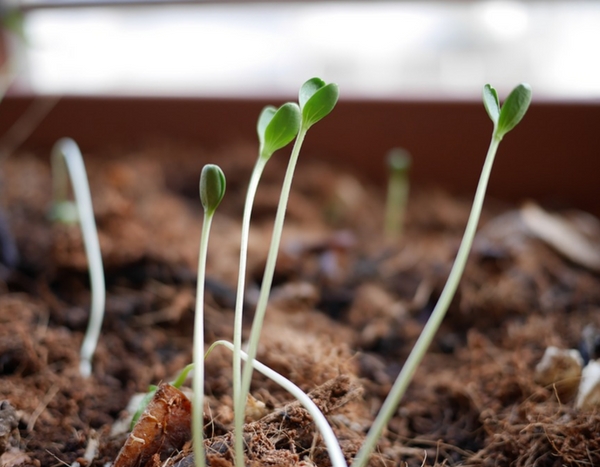
This seed can be sown throughout the year. Fresh seeds of Desmodium gyrans germinate easily in potting compost, at a depth of 0.5cm (0in), or in damp cotton, at a temperature of 25 to 30°C (77 to 86°F). Germination usually takes 10 days to 3 weeks. Dry seeds need to be scarified to germinate; scarification consists of rubbing the very hard envelope that surrounds the seeds with coarse sandpaper to scratch them and allow water to come into contact with the embryo. Propagation by cuttings, as in most legumes, is very difficult.
Cultivation of Desmodium gyrans:
Grow this tropical plant in a large pot that is indoors all year round or taken out to the terrace in summer. It is best kept in a temperature range of 20 to 35°C (68 to 95°F), in a very bright but sunless exposure, and a humid atmosphere. The growing medium should be light, rather acidic, and constantly moist. Install artificial lighting if necessary, especially in winter.
Keep the growing medium slightly moist at all times, especially in summer if you take your plant outside. Use non or low-limestone water to regularly spray the foliage in a dry atmosphere. In winter, reduce watering to twice a month if the temperature in your greenhouse or conservatory drops below 20°C (68°F). If you take your Desmodium outside in summer, bring it back inside before autumn.
To repot Desmodium gyrans, choose a slightly larger pot and make sure to keep the root ball intact. This slow-growing plant should only be repotted every two to three years.
Sowing period
Intended location
Planting & care advice
-

-
-

-

-

-

-

-

This item has not been reviewed yet - be the first to leave a review about it.
Recently viewed products
Haven't found what you were looking for?
Hardiness is the lowest winter temperature a plant can endure without suffering serious damage or even dying. However, hardiness is affected by location (a sheltered area, such as a patio), protection (winter cover) and soil type (hardiness is improved by well-drained soil).

The flowering period indicated on our website applies to countries and regions located in USDA zone 8 (France, the United Kingdom, Ireland, the Netherlands, etc.)
It will vary according to where you live:- In zones 9 to 10 (Italy, Spain, Greece, etc.), flowering will occur about 2 to 4 weeks earlier.
- In zones 6 to 7 (Germany, Poland, Slovenia, and lower mountainous regions), flowering will be delayed by 2 to 3 weeks.
- In zone 5 (Central Europe, Scandinavia), blooming will be delayed by 3 to 5 weeks.
In temperate climates, pruning of spring-flowering shrubs (forsythia, spireas, etc.) should be done just after flowering.
Pruning of summer-flowering shrubs (Indian Lilac, Perovskia, etc.) can be done in winter or spring.
In cold regions as well as with frost-sensitive plants, avoid pruning too early when severe frosts may still occur.
The planting period indicated on our website applies to countries and regions located in USDA zone 8 (France, United Kingdom, Ireland, Netherlands).
It will vary according to where you live:
- In Mediterranean zones (Marseille, Madrid, Milan, etc.), autumn and winter are the best planting periods.
- In continental zones (Strasbourg, Munich, Vienna, etc.), delay planting by 2 to 3 weeks in spring and bring it forward by 2 to 4 weeks in autumn.
- In mountainous regions (the Alps, Pyrenees, Carpathians, etc.), it is best to plant in late spring (May-June) or late summer (August-September).
The harvesting period indicated on our website applies to countries and regions in USDA zone 8 (France, England, Ireland, the Netherlands).
In colder areas (Scandinavia, Poland, Austria...) fruit and vegetable harvests are likely to be delayed by 3-4 weeks.
In warmer areas (Italy, Spain, Greece, etc.), harvesting will probably take place earlier, depending on weather conditions.
The sowing periods indicated on our website apply to countries and regions within USDA Zone 8 (France, UK, Ireland, Netherlands).
In colder areas (Scandinavia, Poland, Austria...), delay any outdoor sowing by 3-4 weeks, or sow under glass.
In warmer climes (Italy, Spain, Greece, etc.), bring outdoor sowing forward by a few weeks.
Shipping country and language
Your country of residence may be:
Your country of residence is:
For a better user experience on our website, you can select:
Your shipping country:
-
 Austria
-
 Belgium
-
 Bosnia & Herzegovina
-
 Bulgaria
-
 Croatia
-
 Cyprus
-
 Czechia
-
 Denmark
-
 Estonia
-
 Finland
-
 France
-
 Germany
-
 Greece
-
 Hungary
-
 Iceland
-
 Ireland
-
 Italy
Italy
-
 Latvia
-
 Liechtenstein
-
 Lithuania
-
 Luxembourg
-
 Malta
Malta
-
 Netherlands
-
 Poland
-
 Portugal
-
 Romania
-
 Serbia
-
 Slovakia
-
 Slovenia
-
 Spain
Spain
-
 Sweden
-
 Switzerland
Language:
-
French
-
 English
-
Spanish
-
Italian
-
German
-
Portuguese
-
Dutch
-
Finnish
My Account
Hello
My wish lists
My cart
Log in / Register
Existing customer?
This form is protected by reCAPTCHA - the Google Privacy Policy and Terms of Service apply.
New customer?
Create an account to track your orders, access our customer service and, if you wish, make the most of our upcoming offers.