Whether shrubby or herbaceous, peonies beautify the garden every spring. With their vibrant white, cream, yellow, pink, or red dresses, they captivate and play the divas… and sometimes, they can be quite elusive when it comes to taking the stage. Imagine for a moment that you decide to deliberately sabotage the show, not out of malice, but simply for the pleasure of seeing how these grand ladies would react?
In this article, we will explore with a dash of irony and a pinch of sarcasm the most effective methods to fail with your peonies, while inadvertently slipping in the secrets to achieving success. Because yes, even in failure, there are lessons to be learned, right?
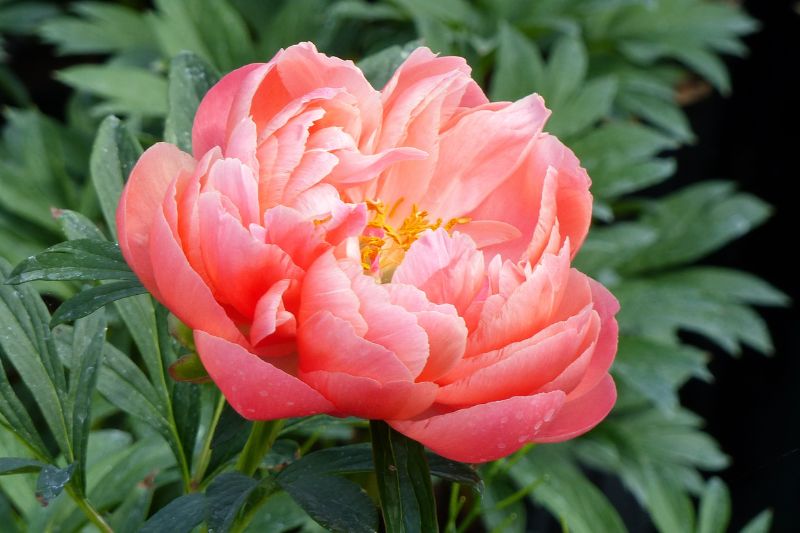
Lesson 1: Ignore the sunlight needs of the peony
To fail with your peonies right from the planting stage, placing them in the shade is a masterstroke. It is there, under the cover of trees and shielded from the sun's rays, that you unknowingly create the perfect setting for a despairing performance. Peonies, deprived of their main light source, will become leggy... or worse, may not flower at all!
But what if, in a fit of rebellion against this scenario of shade and sadness, you decided to change the script? Yes, these garden divas demand sunlight as their spotlight, and that for at least six hours a day! This is their secret to spectacular flowering.
Lesson 2: Neglect the type of soil
In this second act of our gardening opera, the soil plays the role of the conductor, dictating the tempo and quality of our plant stars' performance. By deliberately choosing compact, clayey soil that is, of course, waterlogged, you compose a dissonant symphony for your peonies. Their roots, like frustrated musicians, struggle to find their rhythm, suffocated in an environment that does not allow them to breathe… or to thrive.
Yet, in a surge of rebellion against this underground cacophony, what if you decided to tune the violins? For the secret lies in the composition of the soil! Indeed, peonies appreciate well-drained soil enriched with organic matter (compost will be your friend) and preferably with a neutral pH. The roots of the peonies will then find a vibrant echo, nourishing and allowing for a flowering worthy of the loudest ovations.
Lesson 3: Water too much or not enough
Let’s continue our improvisational theatre, with the main character being: watering. Alternate between abundant watering, worthy of a torrent, and the dryness of a desert. You will plunge your peonies into a state of constant stress. The roots of your plants, like dancers trying to follow chaotic music, are sometimes drowned by a wave of water, sometimes desperately searching for a drop to drink in cracked, thirsty soil. There, it’s certain: the dance will soon come to an end!
However, if you feel inclined not to let them drown or dry out, the key lies in seeking the middle ground. Practice the dance of measured watering, watering when the soil becomes dry to a depth of 2 cm. This balance will provide your peonies with the ideal stage to shine brightly.
Lesson 4: Ignore diseases and pests
Let’s return to our garden scene, where you decide that diseases and pests also have a role to play in this play, without being countered, thus taking centre stage. Your peonies, the main actresses, find themselves vulnerable, exposed to a scenario where they struggle alone against sometimes invisible… but dreadfully effective adversaries. Without your intervention, the garden becomes a tragic scene where fungal diseases and pests become the leading roles. That’s what you wanted, right?
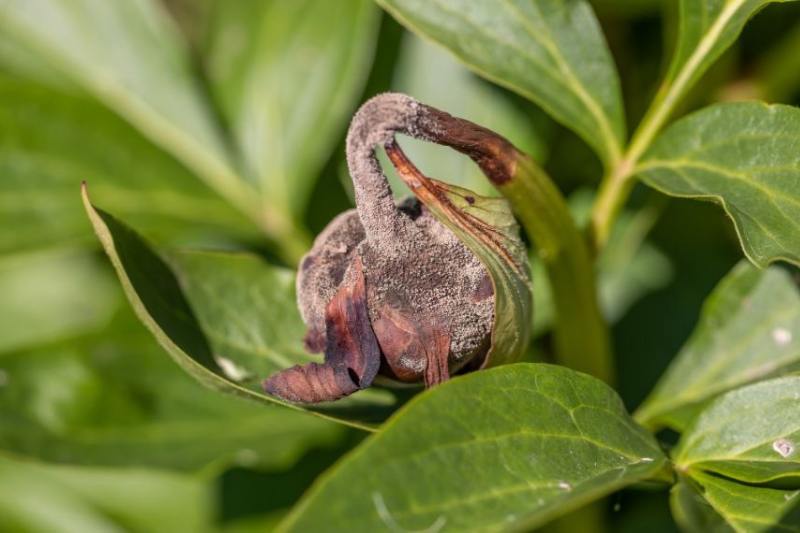
However, by taking on the role of the attentive gardener-director, scrutinising the set for signs of impending harmful intrigue, you can take the necessary measures to protect your peonies. Intervening with targeted treatments and preventive care is like rewriting the script in favour of your peonies, allowing them to play their role with brilliance.
Lesson 5: Improvised pruning
And for the final act of this article, what if you transformed into "Edgar with the silver hands," a doppelgänger of the famous Edward, but with less talent? Prune the peonies with scissors that you haven’t cleaned beforehand, without a plan or discernment. You might think you’re shaping an avant-garde masterpiece, while in reality… you’re just improvising, cutting here and there, in the middle of the flowering period! This reckless approach is the perfect scenario for a botanical drama, where the peonies, the actresses of their own tragedy, find themselves stripped and weakened… The perfect melodrama!
However, for gardeners who, in a burst of controlled creativity, aspire to sculpt their garden, wait until after flowering to intervene, when the curtain falls and the peonies are ready to regenerate backstage. This thoughtful pruning, far from being an improvisation, is a meticulous rehearsal for next year’s show. It not only helps keep the plant healthy but also encourages even more spectacular flowering, ensuring that the next act is welcomed with even more brilliance.
Whether shrubby or herbaceous, peonies beautify the garden every spring. With their vibrant white, cream, yellow, pink, or red dresses, they captivate and play the divas… and sometimes, they can be quite elusive when it comes to taking the stage. Imagine for a moment that you decide to deliberately sabotage the show, not out of […]
As summer draws to a close and the days shorten, a hint of melancholy may arise in the gardener. This is the end-of-summer blues, a nostalgia for the past splendour of the garden in full bloom. Rather than fearing the end of summer, rejoice! While many plants fall asleep after the summer heat, others continue to bloom tirelessly or are just beginning to flourish. From ephemeral annuals to late-flowering perennials and long-lasting varieties, as well as flowering shrubs and summer bulbs, your garden is far from going into hibernation. Salvias, Echinaceas, Sedums, Lavateras, and Hydrangeas, combined with the last blooms of annuals, extend the show! These late flowers bring new life to the garden when most plants take their bow. In the late season, they come to the rescue of the depressed gardener and flourish with renewed vigour. Let’s discover these long-lasting flowers that bloom from the end of summer until autumn to extend the beautiful season!
Annual flowers: an ephemeral yet spectacular display
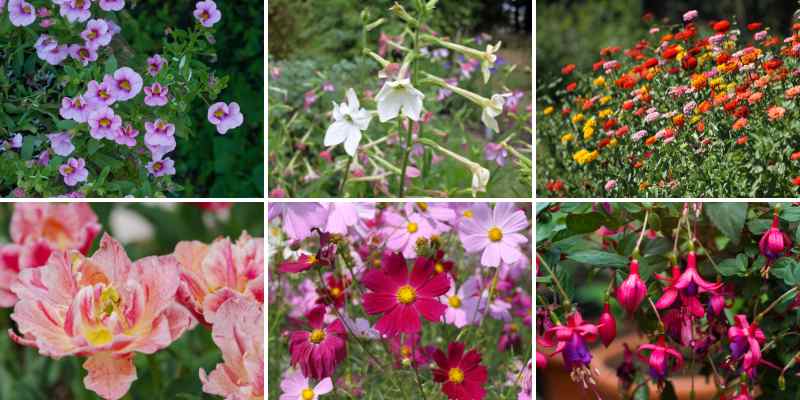
Despite their ephemeral nature, annuals and biennials are essential assets for generously flowering the garden for long months. They adapt to all desires, whether in the ground or in pots, creating often very colourful and cheerful displays. They come in an infinite variety of colours allowing for endless combinations, whether in gradients or monochromes, elegant or vibrant! Additionally, they are easy to grow and maintain, filling gaps between shrubs or perennials. These beautiful annual flowers bloom from June and generally for 5 months, sometimes longer, without interruption, ensuring a whole flowering season. Despite their limited lifespan, these annuals are an excellent way to keep your garden vibrant and colourful until autumn's doorstep. Planting plugs occurs in spring, and seeds can also be sown directly in place when the soil is well warmed. They are stunning in mixed borders, at the edges of beds, as well as in pots or window boxes. They are very easy to combine with other summer blooms, perennials or summer bulb plants. Among the champions of floral abundance:
- Ornamental Tobaccos orNicotiana: add a touch of exoticism, with their colourful trumpet-shaped flowers ranging from white to red and bright pink, fragrant in the evening.
- Petunias, Surfinias and Calibrachoas are remarkable for their generous and continuous flowering lasting from May until the first frosts. With their trumpet-shaped flowers, bicoloured, tricoloured, or striped, they offer a myriad of vivid and deep or pastel colours, sometimes even bordering on kitsch.
- Annual Lobelias that bloom continuously until the first frosts and come in many vibrant colours.
- The elegant Cosmos, with their large simple and airy flowers in a wide range of colours, renew abundantly from June to September.
- Godetias (or Clarkias), another charming annual plant, very floriferous from June to September with large silky flowers painted in various often soft, solid or variegated tones.
- Pelargoniums or Geraniums (zonal pelargonium, ivy pelargonium or "king of balconies") are essential for adding relief and colour to beds, borders, and sunny spots, hanging baskets, and window boxes from May to October. There is something for every taste and situation.
- Zinnias are lovely late-flowering daisies. Resilient and prolific, they are among those unmissable annual plants ensuring continuous flowering in vibrant, sometimes even exuberant colours, until the first frosts.
- Fuchsias, whose bell-shaped flowers, either simple or double and often bicoloured, bloom from May-June to September-October.
But also: Coreopsis, marigolds (Calendula), African marigolds (Tagetes), nasturtiums, bacopas, Dipladenias, annual Rudbeckias, diascias, Osteospermums, all in bloom from spring until the first frosts.
Read also:
Perennials: the promise of lasting beauty
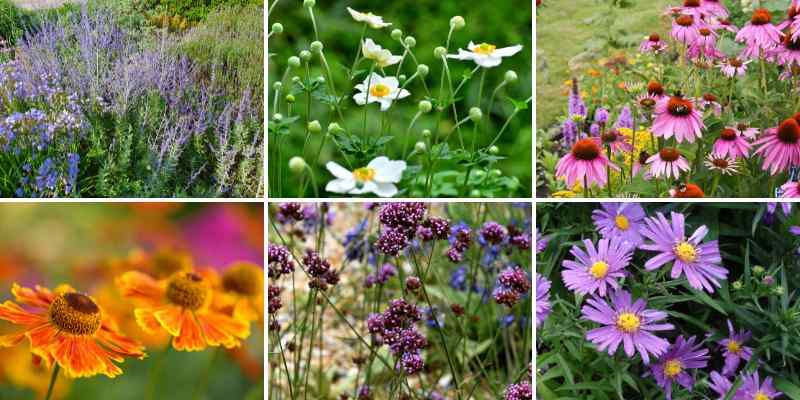
Some generous or late-flowering perennials extend the beautiful season into winter. Many of them continue to bloom once the summer's heat has faded. Their flowering spans from early summer to frost. They return each year, requiring little maintenance and offering a myriad of colours in return. Depending on their size, they will enliven the foreground of beds, fill gaps, or provide structure and lightness. Here is a selection of essential perennials that will bloom until September-October:
- Asters, a must-have for late blooms. These very hardy perennials, like the autumn asters, such as Aster novi-belgii, light up the late season with their starry and colourful blooms! They are covered from August to November with numerous small white, blue, purple, or pink flowers. Melliferous, they attract a multitude of pollinating insects.
- Japanese Anemones, with their delicate star-like flowers, are essential in late summer and autumn beds. These perennials, typical of the "vicar's garden," are among the most beautiful late summer flowers for partial shade, blooming in luminous corollas from September to November. Their delicate beauty contrasts with their robustness, as they can tolerate a variety of soil and light conditions (they accept sun in humus-rich soil).
- Echinaceas, with their vibrant daisy-like flowers, are robust and reliable perennials, offering spectacular blooms in late summer and until September-October without interruption. Fertile, very easy to grow, and accommodating, they bloom in naturalistic beds, borders, and English mixed borders. After flowering, the brown cones suspended on their inflexible stems will extend the decorative effect into the dreary season.
- Perovskias, with their silvery aromatic foliage and lavender-blue flowers, like Perovskia atriplicifolia ‘Blue Spire‘, form a graceful bush blooming from June to September, even until October in Mediterranean climates. This particularly long flowering attracts butterflies, bees, and bumblebees all summer.
- Buenos Aires Verbenas are also beautiful perennials in bloom from summer to autumn. All light and airy, their mauve-blue flower umbels are accompanied by a constant flurry of foraging insects.
- Sedums or Autumn Stonecrops (‘Autumn Joy’, for example) bring colour in early autumn when the garden starts to lack flowers. They bloom from August until November. With their colours ranging from deep to soft or bright, they add much charm to the late season.
- Chrysanthemums are a great way to achieve colour late in the season. They reward us from September to November with their colourful daisy-like flowers beautifully complementing the fiery foliage and last blooms of autumn.
Among other late-flowering perennials, consider Gauras, with their butterfly-like flowers dancing in the breeze, the Heleniums or Autumn Hélénies whose daisy-like flowers come in a wide range of warm tones and truly set the garden ablaze at the end of the season. Also think of Achilleas, Echinops, Phlox paniculata, Anthemis, and ornamental salvias such as the Salvia nemorosa "Blue Bouquetta" Alklf, a variety of perennial sage that offers particularly long and abundant flowering from May to October in an incredible colour, and kniphofias, some varieties of which display their fiery spikes until October (Kniphofia rooperi, ‘Traffic Lights’).
- Discover our collection of late-flowering perennials
Flowering shrubs: a screen of colours until autumn
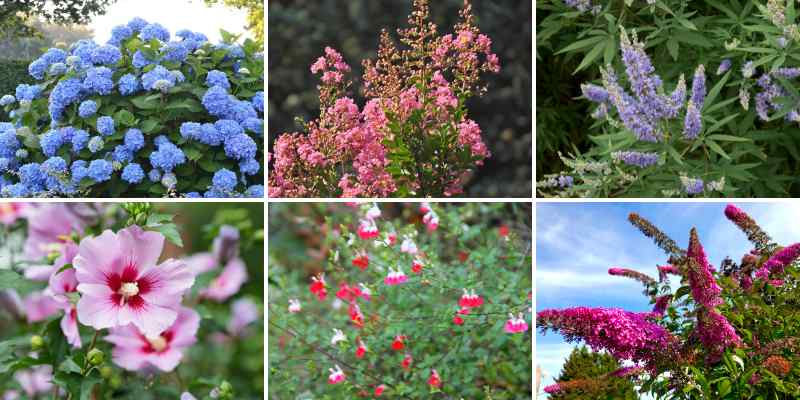
Summer-flowering shrubs charm us with their colourful blooms and provide structure, texture, and colour to the overall decor. They are essential in sunny or semi-shaded areas, in hedges, beds, as standalone plants, or even in pots on the terrace for smaller varieties. Some are still in bloom at the end of the season, or begin to flower from mid-August to late September, gently announcing the arrival of autumn:
- The Buddleia or Butterfly Bush, whose colourful and fragrant flower spikes irresistibly attract butterflies renew from July to September-October (‘Adonis Blue’, 'Nanho Purple', Pink Panther).
- The Crape Myrtle (Lagerstroemia) or Summer Lilac that bloom in large dense bouquets of frilly flowers often offering a second flowering sometimes until October (‘Souvenir d’André Desmartis’, 'Périgord Pourpre’).
- The Hibiscus syriacus or Garden Althea that rewards us all summer with simple or double delicately crumpled flowers depending on the varieties, ranging from white to purple. They bloom in July, rebloom in August to flower again from late summer to the entrance of autumn (‘Eruption®’, ‘French Cabaret’).
- The classic Hydrangea or Hydrangea macrophylla which, with its large globular inflorescences, ensures a spectacle in late summer, especially as their flowers change colour as they mature. 'Endless Summer’ is part of an extremely remontant series, as it flowers from early summer until October.
- The Lavatera which forms very pretty long-flowering bushes. It produces, from June to September-October, a multitude of lovely satin-like flowers resembling hibiscus flowers, in pink, blue, or white.
- The Siberian Sage or Perovskia that gracefully fits into natural scenes, forming a graceful bush with aromatic silvery foliage and lavender-blue flowers. 'Silvery Blue‘ offers an endless summer bloom of very bright lavender blue.
- Flowering Shrubs are very floriferous shrubs whose flowering extends from May to October depending on the climate. Like Hot Lips’, they are capable of blooming abundantly from late summer to frost.
Among other late-flowering shrubs, we can mention ceanothus, which produce clusters of vibrant blue flowers, spiraeas, whose small delicate flowers attract many pollinating insects, hardy fuchsias (Fuchsia magellanica 'Ricartonii') or the Vitex agnus castus ‘Latifolia’ which adorns itself with violet-blue flower panicles in August-September.
Summer bulbs: an underground surprise
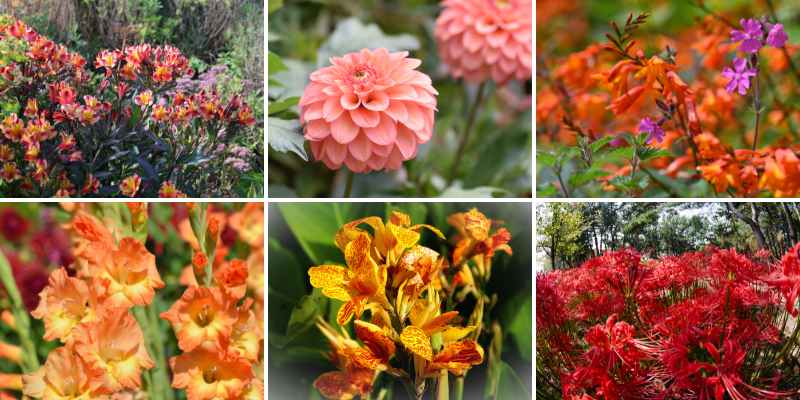
Designed to colour your beds, borders, and pots until autumn, these buried treasures reveal their late blooms when other plants begin to fade. Among the most beautiful bulb flowers that we can enjoy fully until autumn:
- Dahlias are the champions of long-lasting blooms, from June or July to September or October (until November in temperate climates). Ball Dahlias, giant or dwarf, for beds, decorative, cactus or semi-cactus, or even landscape”, fanciful or sober, exuberant or romantic, these generous summer-flowering bulbs offer an infinite choice for the gardener. They also produce excellent cut flowers. Their brilliant display in late summer and autumn is a reward for the gardener's patience. Be careful, as they are frost-sensitive, they need to be dug up in autumn in cold regions.
- Inca Lilies or Alstroemerias are magnificent vigorous bulbous plants that produce a multitude of stylised, brightly coloured flowers, often brown-striped from June to October. They are suitable for both bouquet making and for decorating beds and pots.
- Gladioli are another bulbous plant that blooms in grand style, from July until September-October, showcasing their long colourful spikes. They accompany vegetables right into the vegetable garden!
- Cannas, with their large tropical leaves and flamboyant flowers, add an exotic and lush note in late summer. They can reach heights of 1.5 to 2 m. We appreciate them for their warm-toned blooms, yellow, orange, or red, as well as for their extremely decorative foliage. Some, like Canna 'Durban', will bloom from July until frost (before being brought indoors for winter).
Finally, do not overlook the Lycoris, also known as red spiders. These bulbs offer a fascinating display with their bare stems emerging from the ground in late summer, followed by exotic trumpet-shaped flowers, Eucomis, and the Crocosmias that bloom in late summer for two months, in fiery colours that pair well with autumn foliage.
- All our summer bulbs
Grasses: the dancers of the ending summer
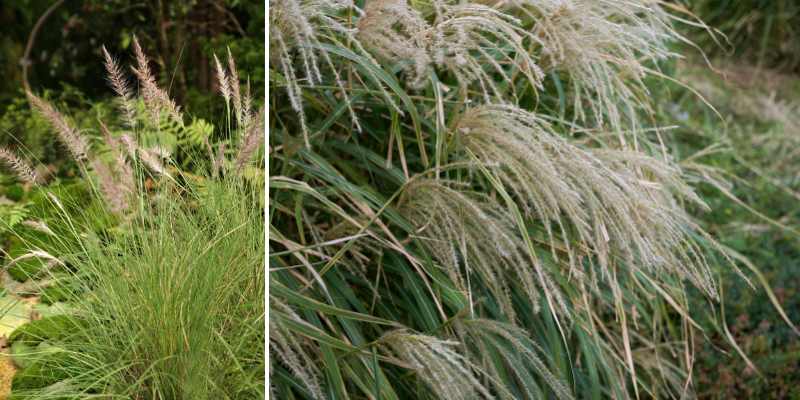
Grasses are essential plants for any gardener wishing to extend the beauty of their garden beyond summer. Their beauty reveals itself at the end of the season and persists even in winter when their stems dry. Beyond their fine and graphic foliage, grasses are also decorative with their light, fine, or feathery blooms. With their graceful and moving appearance, they can mask deflowered plants and remain decorative even in winter when their spikes are faded. Their airy silhouette and subtle hues harmonise perfectly with the colour palette of late blooms, adding texture and movement to the garden landscape. They are ideal companions for autumn-flowering perennials such as asters, hardy chrysanthemums, and Japanese anemones. Among those that bloom in late summer:
- Pennisetums, or "Fountain Grass," stand out with their remarkably silky spikes, dancing elegantly in the wind. While all bloom until October, some, like Pennisetum alopecuroïdes ‘Hameln’ reserve their broom-shaped spikes in cream-white with brown reflections for the very end of summer, in September-October.
- Miscanthus, or "Chinese Reed", which from August to October rewards us with a rich bloom, pink, red, or silver depending on the varieties, in silky panicles that shimmer under the declining sun. Their foliage, ranging from green to golden, offers a superb contrast with the colourful flowers.
- Don’t forget the “Diamond Grass” (Calamagrostis brachytricha) which is among the most beautiful autumn grasses with its beige spikes tinged with purple that endure even under frost.
As summer draws to a close and the days shorten, a hint of melancholy may arise in the gardener. This is the end-of-summer blues, a nostalgia for the past splendour of the garden in full bloom. Rather than fearing the end of summer, rejoice! While many plants fall asleep after the summer heat, others continue […]
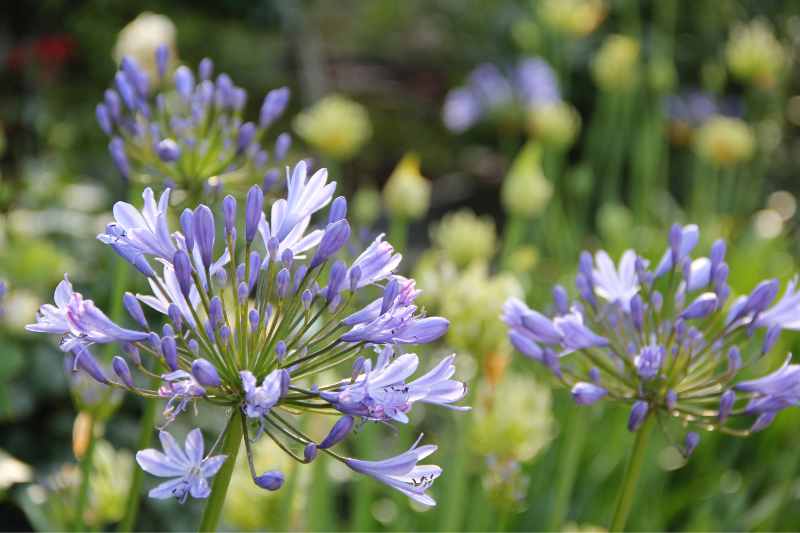
In the peaceful world of gardening, a new threat is emerging, sending shivers down the spines of agapanthus lovers across France. Indeed, the agapanthus gall midge, a small African insect that was previously harmless, is becoming a growing scourge for these majestic plants. With an increase in cases in France, the question is no longer whether, but rather when and how this pest can be stopped. What is the impact of the agapanthus gall midge on our agapanthuses? How can we identify the signs of this infestation? Are there effective control methods to protect agapanthuses across the country? The beauty of our gardens is at stake: it is time to act!
Agapanthus gall midge: what is this insect?
The agapanthus gall midge, or Enigmadiplosis agapanthi, is a particularly harmful pest for agapanthuses. This insect, which belongs to the Cecidomyiidae family, originates from South Africa, like the agapanthuses themselves, but has since migrated to other parts of the world, including Europe.
The agapanthus gall midge is a tiny midge whose larvae develop within the buds and stems of agapanthuses, causing deformities and often inhibiting flowering. The damage can be significant, potentially leading to the death of the plant in the most severe (but very rare) cases.
The insect is so minuscule that only symptoms can help us determine its presence rather than direct observation.
What are the symptoms of an infestation?
Signs of an infestation by the agapanthus gall midge may include deformed or unopened flower buds, stems that wilt or turn yellow or brown, and the presence of small white larvae or orange pupae inside the stems or buds. The larvae of the agapanthus gall midge develop within the flower buds themselves. In cases of heavy infestation, the entire flowering may be halted in agapanthus crops.
How to act?
Controlling this pest can be challenging, as there is no specifically approved control method for the agapanthus gall midge. Control methods include the removal and destruction of the infested parts of the plant. But there is no need to uproot or remove your agapanthuses! Research is ongoing to find other effective control methods against this pest. However, we remain hopeful that a natural predator will come to regulate the gall midges naturally. Fingers crossed!
What is the situation in France?
Let’s not panic just yet! In Europe, the first official observations were recorded in the UK in 2015, then in the south-west of France in 2017 and later in Brittany in 2019. Since then, the agapanthus gall midge has been steadily progressing without the situation being, for now at least, truly alarming. However, the national agapanthus conservatory on the island of Bréhat, in Côtes d'Armor, is sounding the alarm and urging gardeners to be vigilant. Be sure to check your agapanthuses at home, in your gardens, and act quickly by removing the parts of the plant suspected of being attacked by this gall midge.
In Belgium, for now, the agapanthus gall midge seems to be absent. (Note: yes, we assure you, certain agapanthuses more resistant to cold, such as Agapanthus 'Black Buddhist', can be grown in Belgium and northern France, but in well-drained soil or in pots!)
To learn more, here is the document from the French Ministry of Agriculture on the subject.
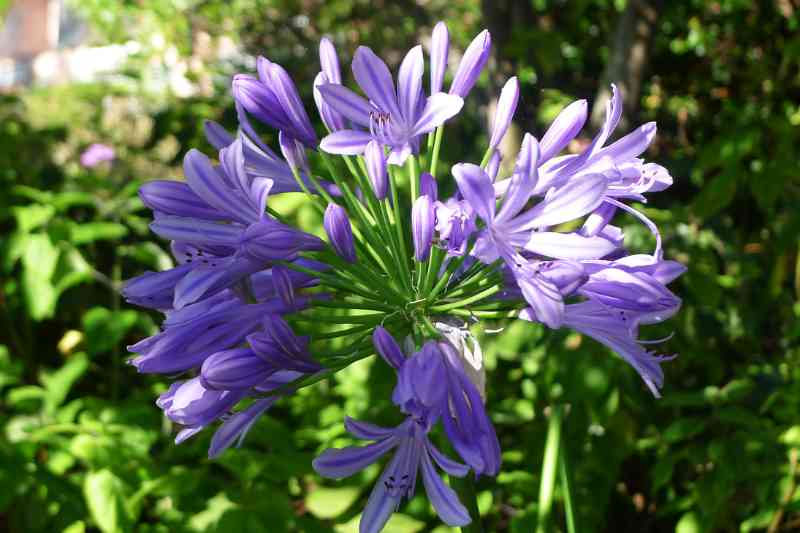
In the peaceful world of gardening, a new threat is emerging, sending shivers down the spines of agapanthus lovers across France. Indeed, the agapanthus gall midge, a small African insect that was previously harmless, is becoming a growing scourge for these majestic plants. With an increase in cases in France, the question is no longer […]
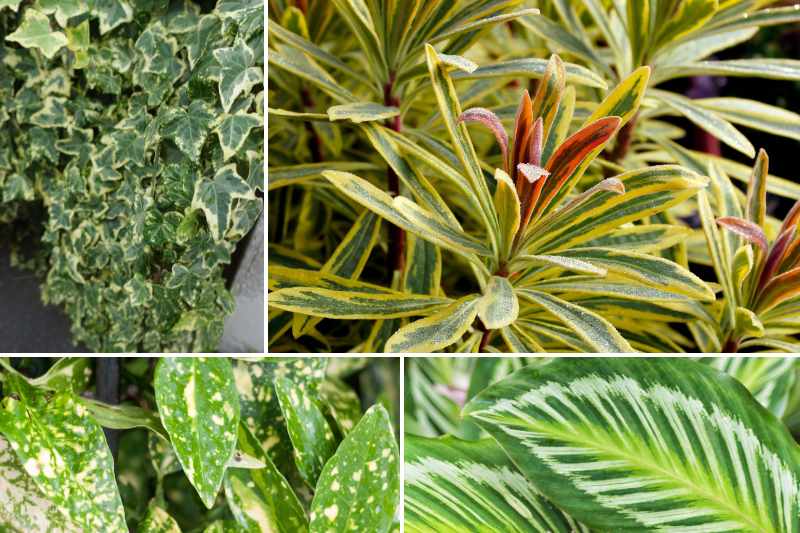
We love variegated foliage... or not. But in any case, it never fails to leave gardeners indifferent. You can find perennials, trees or shrubs with variegated or marbled foliage in white, cream, yellow, or another colour... Sometimes simply marginate, sometimes almost entirely devoid of green... But the question we are asking today is: what causes this foliage or another part of the plant to become bicoloured or multicoloured?
What is a variegated foliage?
We refer to variegation when a part of a leaf, flower, or even fruit appears "discoloured." These discoloured parts are completely or partially devoid of chlorophyll, the pigment that gives the green colour and enables photosynthesis.
It is important to know that a green leaf contains chlorophyll (we should even say chlorophylls, as there are several types), but also a certain amount of other pigments that are more or less hidden: carotin, xanthophyll, anthocyanin... When chlorophyll disappears, the other pigments become visible. This is what gives the yellow, orange, red, or brown colours of leaves in autumn when chlorophyll naturally fades. For variegations, it works on a similar principle, except that it is not the decrease in light that causes chlorophyll to disappear, but other reasons. When chlorophyll partially disappears, we end up with white, cream, yellow... and sometimes even pink or red spots.
Where do these variegations come from?
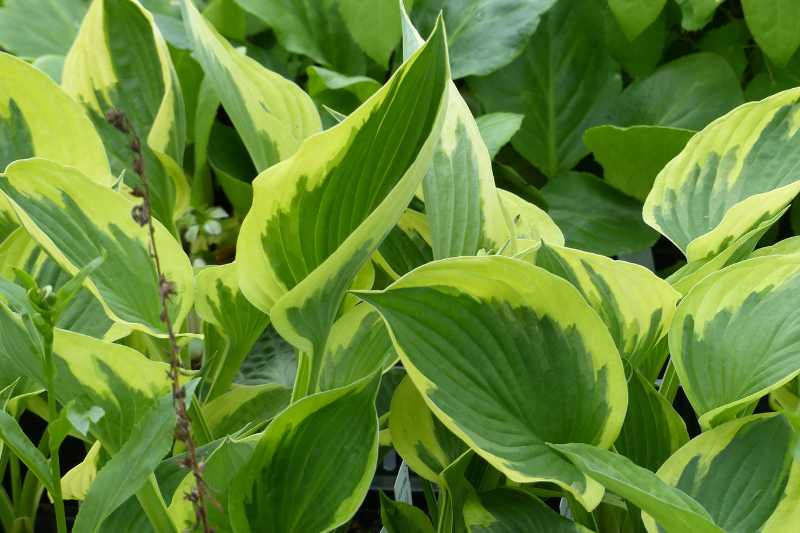
Variegations in a leaf can arise from various causes:
The most common case is mutation-induced variegation. A young seedling or part of a plant mutates and suddenly becomes variegated. Since the variegation is not stable, and therefore not sexually reproducible, these plants should be propagated vegetatively (cuttings, layering, grafting). Be on the lookout for such mutations in your own garden. You never know, you might obtain a remarkable new variety.
Variegations can also be caused by a virus. This is rarer, but it does happen. A benign virus infects the plant, which in response produces variegated parts (leaves, flowers, fruits). This is the case with most variegated-leaved Hibiscus, such as Hibiscus 'Summer Ruffle', or with bicoloured tulip varieties;
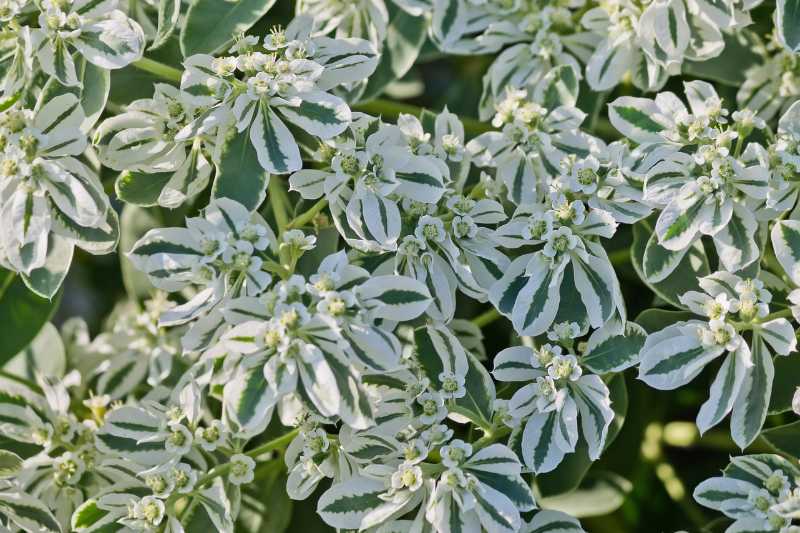
Finally, some variegations are entirely natural. Indeed, certain plant species have evolved to develop variegated or punctate parts. Botanists do not have explanations for all these species. However, it can be said that the natural variegation of certain species is a defence mechanism, as seen in Hypoestes which produce leaves speckled with small dots or in Adelonema walisii which reveals very variegated leaves of yellow-cream. The former gives the illusion that the plant has already been eaten by an insect, while the latter is camouflaged in the decor to avoid being browsed by herbivores. Some species may also use variegations to more effectively attract pollinators, as seen in Euphorbia marginata.
But is it serious, doctor?
As mentioned, even if variegation is caused by a virus, this virus is completely benign. However, having a low chlorophyll content within a leaf can lead to reduced vigour. In other words, a variegated variety will often grow a little slower than its green-leaved counterpart. But don’t let that stop you from planting them!
One small note, however: some variegated mutations are so low in chlorophyll that it would be impossible to propagate them by cuttings, as the cutting would not have enough energy to produce roots. These mutations are therefore propagated by grafting (which significantly increases the purchase price).
A bit of botany
We find Latin terminologies in some species names or the names of old variegated varieties such as: variegata, marginata, pulverulenta...
- Variegata for variegation: meaning variegated, as in Cornus controversa 'Variegata';
- Maculata: meaning maculate, thus a large coloured spot, as in Phlox maculata or Begonia maculata;
- Marginata: meaning marginate, thus bordered by a fine coloured band, as in Agave angustifolia 'Marginata';
- Striata : meaning striate or marbled, thus marked by coloured bands of varying widths, as in Bletilla striata;
- Punctata : meaning punctate, thus sprinkled with small coloured dots or spots, as in Lysimachia punctata;
- Pulverulenta : meaning it seems to have been sprinkled with a lighter substance, as in Catalpa speciosa 'Pulverulenta';
- Reticulata : which colouring follows the pattern of the veins, as in Iris reticulata;
- Crotonifolia : with Croton-like leaves (a famous houseplant - Codiaeum variegatum), thus exhibiting irregular discolouration, as in Aucuba japonica 'Crotonifolia'.
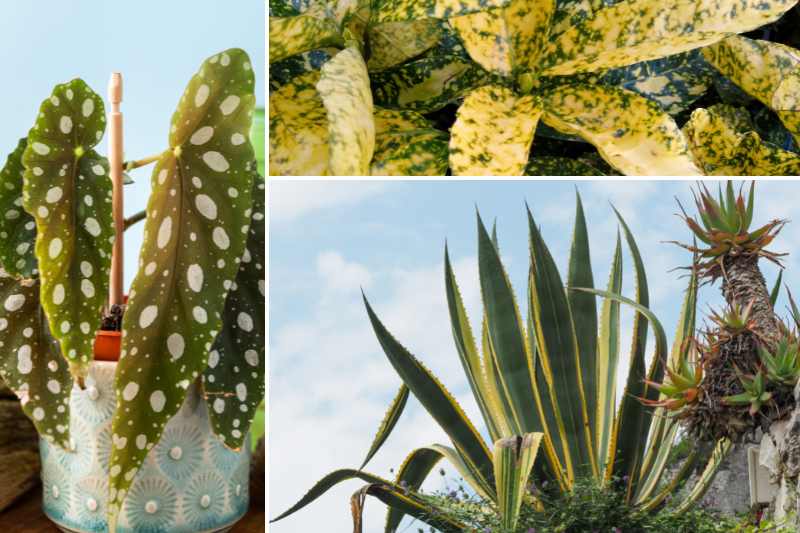
Did you know? Since 1956, breeders have not been able to use Latin to name new varieties and cultivars. The choice has mainly fallen on the English language, although exceptions exist. This is why we find words like 'Gold', 'Silver', 'Rainbow', 'Cream'... in the names of plant varieties featuring variegations.
We love variegated foliage… or not. But in any case, it never fails to leave gardeners indifferent. You can find perennials, trees or shrubs with variegated or marbled foliage in white, cream, yellow, or another colour… Sometimes simply marginate, sometimes almost entirely devoid of green… But the question we are asking today is: what causes […]
Hellebores are perennials distinguished by their beautifully coloured winter flowering. Their flowers come in shades of pink, red, purple, white, and yellow, with petals surrounding a very decorative bouquet of central stamens. Their flowers are sometimes beautifully speckled with purple spots. A new range of hellebores has recently joined our catalogue: we are proud to present these varieties to you today!
To learn everything about hellebores, feel free to consult our complete guide: “Hellebores: planting and cultivating them”
1 - What are the advantages of these new varieties?
The new varieties we are presenting today are from the ViV and HGC ranges (Helleborus Gold Collection). They encompass several dozen varieties, offering a very wide choice! They are particularly notable for being produced through in vitro propagation.
In vitro propagation is a multiplication technique carried out in a laboratory that allows for the production of new young plants from a fragment of the mother plant. It is somewhat akin to micropropagation: a small section of the plant is taken, placed in a suitable medium, and it will develop into a complete young plant.
This guarantees uniform young plants: the new young plants are rigorously identical to the one from which they originated, as they are clones with the same genome. This represents a significant advantage in the case of hellebores, as when they are multiplied by sowing, the new young plants exhibit colour variations and are generally not true to the original variety. Indeed, classic varieties hybridise very easily with one another.
In vitro hellebores therefore provide an excellent solution to ensure variety conformity. Moreover, with selective breeding work, the hellebores from these ranges are generally more compact, more floriferous, and they offer more colourful and intense flowering. They are also free from viruses and diseases.
Discover the most beautiful varieties
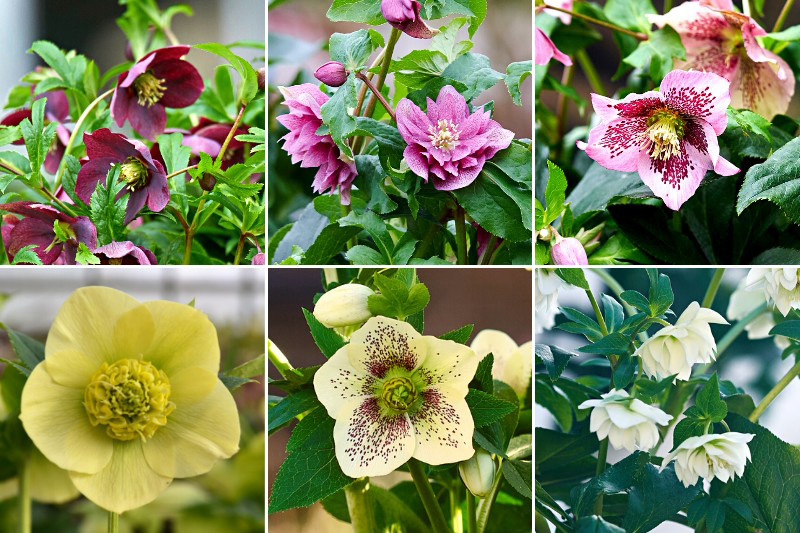
Hellebores from the ViV range:
- Hellebore ViV Victoria: This is probably one of the most beautiful Oriental hellebores. It is a stunning variety with violet flowers, featuring five petals, contrasted by a bouquet of yellow stamens. It forms a compact clump, about 40 cm tall.
- Hellebore ViV Ariana: ‘Ariana’ is a beautiful variety with downward-facing double flowers: these consist of several rows of imbricate petals, in a purplish pink colour, speckled with small purple spots. This gives the flowers a sophisticated and elegant appearance.
- Hellebore ViV Celestina: This superb variety flowers early, as soon as September, producing simple flowers with light pink petals, beautifully speckled with purple.
- Hellebore ViV Lucrezia: ‘Lucrezia’ stands out with its very bright yellow flowers! They consist of five petals, surrounding a central collar and a heart of stamens. They bloom from January to February, bringing a touch of light in the middle of winter!
- Hellebore ViV Maeva: This is a beautiful variety with simple flowers, featuring yellow petals speckled with small purple spots. This makes its flowering intense and contrasting! With its compact size, it is well-suited for pot cultivation.
- Hellebore ViV Gianina: ‘Gianina’ is an early variety, flowering as soon as September, and offers beautiful pure white double flowers. The flowers are large, consisting of several rows of petals, and feature a bouquet of yellow stamens at the centre.
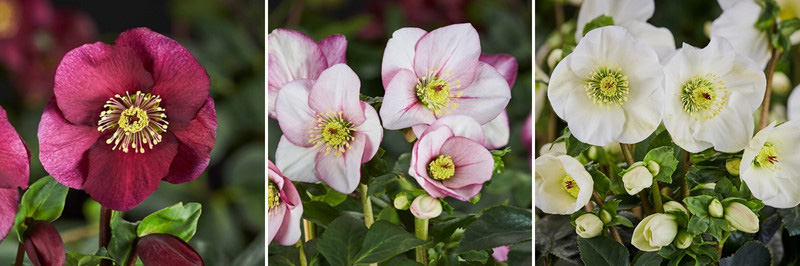
Hellebores from the HGC range:
- Hellebore lemperii Leona: This hellebore bears large flowers with dark red petals, surrounding a heart of yellow stamens, well contrasted. Its intense colour is appreciated! It is ideal in pots, to bring colour to a balcony or terrace.
- Hellebore lemperii Liara: ‘Liara’ bears large simple flowers (up to 10 cm in diameter) from December, consisting of five petals in pale pink, with a deeper pink reverse, offering beautiful colour nuances. This is a very romantic flowering!
- Hellebore lemperii Linn: This variety offers simple cream-white flowers, adorned with yellow stamens. It forms a well-compact clump and bears particularly large flowers, reaching about 15 cm in diameter.
3 - How to cultivate them?
Hellebores will thrive if you plant them in shade or partial shade, in rich, cool, but well-drained soil. They have the advantage of being perfectly hardy, tolerating temperatures of around –15 to –20 °C. These new varieties, being floriferous and compact, are perfect for pot cultivation on a terrace, balcony, or windowsill, but they can also be planted in the ground. You can pair them with the decorative foliage of heucheras, the beautiful yellow flowering of Eranthis hyemalis, and the delicate white bell-shaped flowers of snowdrops. Also consider winter-flowering shrubs, such as Viburnum x bodnantense 'Dawn', Daphne odora 'Aureomarginata', and Hamamelis.
4 - To learn more
- Our complete guide: “Hellebores: planting and cultivating them”
- Find all our articles on hellebores by clicking here.
- For more options, discover our entire range of hellebores
- The ViV hellebores website and the HGC hellebores website
Hellebores are perennials distinguished by their beautifully coloured winter flowering. Their flowers come in shades of pink, red, purple, white, and yellow, with petals surrounding a very decorative bouquet of central stamens. Their flowers are sometimes beautifully speckled with purple spots. A new range of hellebores has recently joined our catalogue: we are proud to […]
Floriferous, understated, and sturdy, this sums up the qualities of this essential shrub for summer gardens.
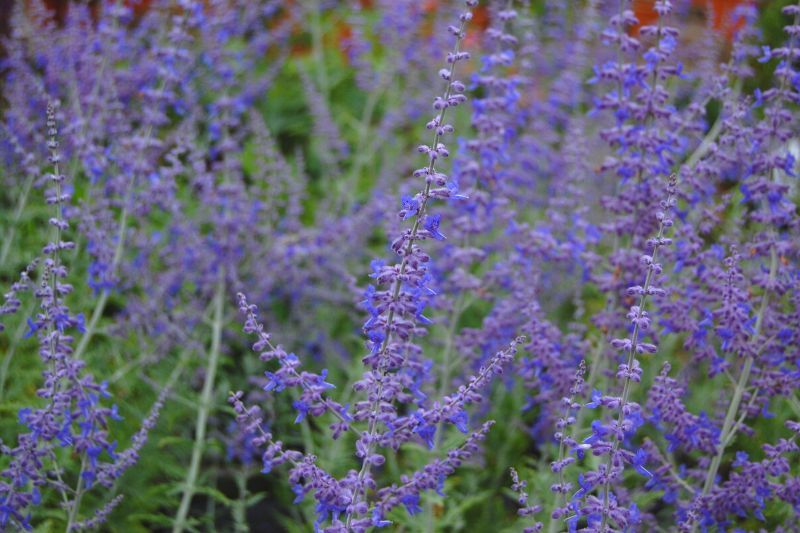
The 'Blue Spire' variety is one of the few plants that flowers continuously from June to September. It forms a large bushy clump of 1.20 m in height and produces fine stems adorned with slender spikes laden with lavender-blue flowers, exceptionally generous in number. Its small, dentate, grey-white foliage is highly aromatic, indicating excellent adaptation to dry, even arid summers. Airy and luminous, the Afghan sage fits seamlessly into sunny borders, thriving in well-drained, rather poor soils.
Planted in my garden near Aix-en-Provence, in a border for 7 years, this variety grows effortlessly, without watering, and thrives regardless of conditions. Resistant to wind, cold, and severe drought, indifferent to the presence of lime, it is for its incredible robustness that I selected this variety. It enlivens the garden with its steel-blue plumes alongside gauras, bushy sages, lavenders, and California fuchsias.
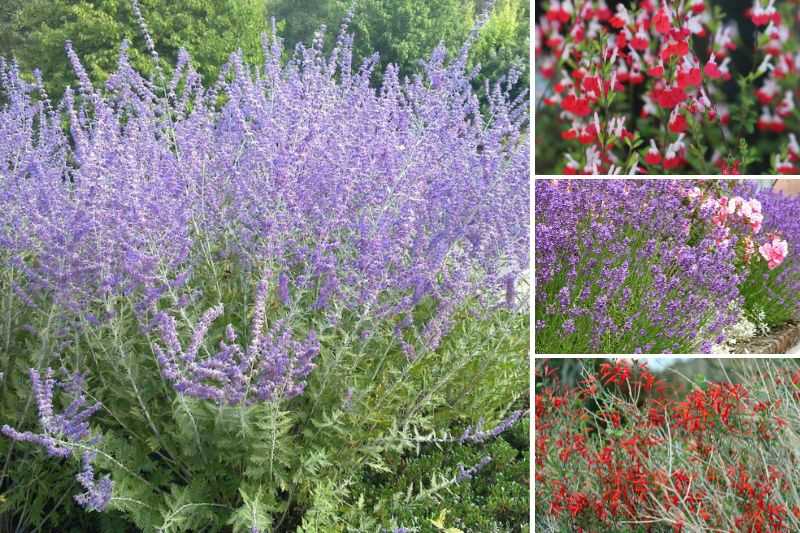
This is a plant that requires no maintenance other than a severe pruning with shears at the end of winter: I simply cut it back to 15 cm above the ground. One last piece of advice, overly fertile soil will lead to more vigorous growth but will harm the density of the plant, as the bush will tend to open up. Don’t hesitate to plant it in soil mixed with sand and gravel.
Its strengths:
- Grows in full sun
- Drought-resistant
- Robust against diseases
- Requires very little maintenance
- A plant of great simplicity
Floriferous, understated, and sturdy, this sums up the qualities of this essential shrub for summer gardens. The ‘Blue Spire’ variety is one of the few plants that flowers continuously from June to September. It forms a large bushy clump of 1.20 m in height and produces fine stems adorned with slender spikes laden with lavender-blue […]
The Agapanthus 'Navy Blue', also known as ‘Midnight Star’, is a very popular variety of agapanthus in northern gardens and for good reason, it is one of the few that withstands the cold so well (it can survive down to about -10°C). It is also one of the few to provide a myriad of flowers in a deep navy blue that is intense.
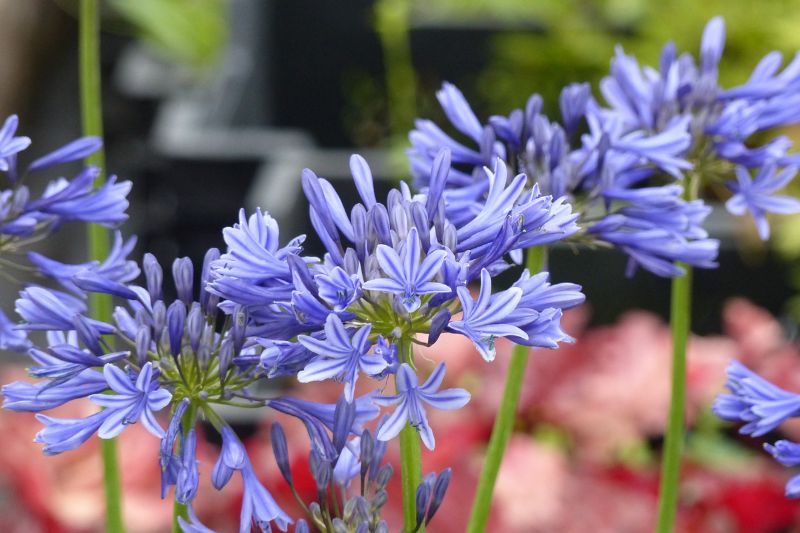
Particularly floriferous and vigorous, this medium-sized variety does not exceed 60 cm in height. It has a deciduous foliage of wide, bright green ribbons that elegantly covers the ground throughout the beautiful season. When its flowers appear, usually in July-August, it transforms into a bouquet of intense blue.
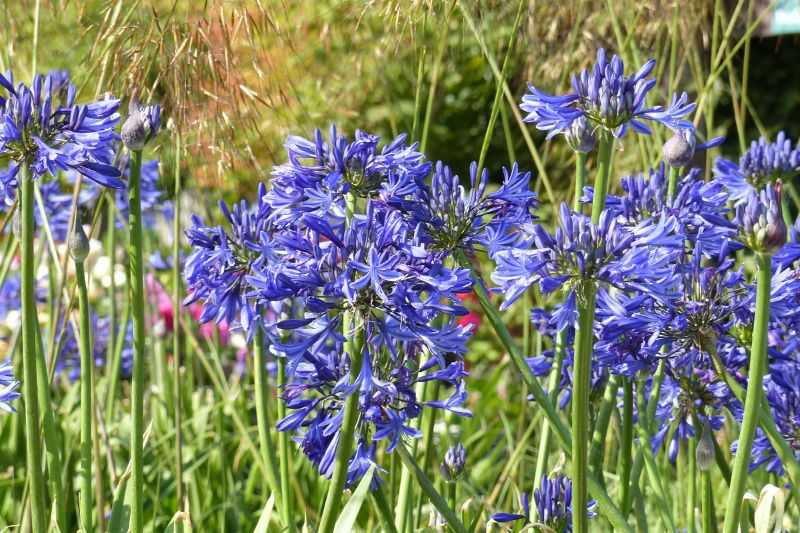
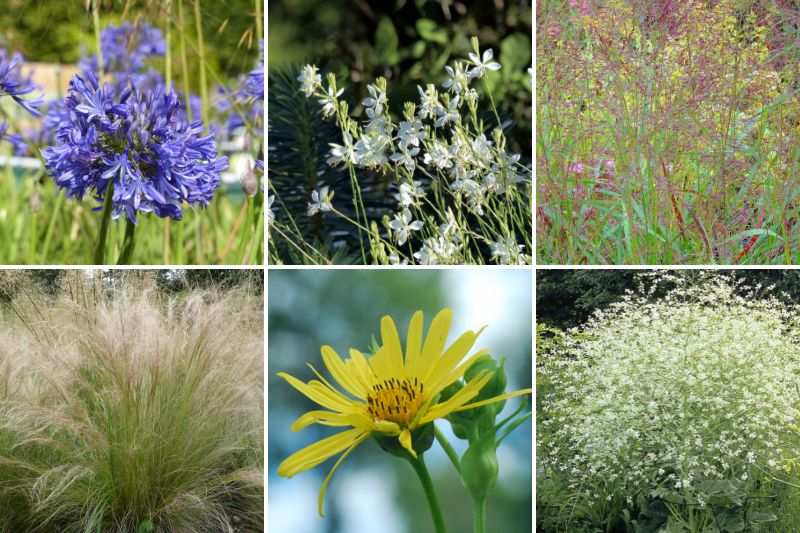
It is in a naturalistic garden, alongside Gaura, Stipa, Panicum, Crambe cordifolia and Silphium that this variety has thrived in my garden for nearly 20 years now. It has endured winters well below -10°C, scorching summer heat, and yet it is still here. From a single plant, which I divide every 4 years at the end of winter, I propagate it in my borders, and it now covers 5 m².
Final tip: To keep it thriving in my clay soil, at planting, I replace my sticky soil with pure sand (2 to 3 times the volume of the stump) so the stump is protected from excess water in winter.
The Agapanthus ‘Navy Blue’, also known as ‘Midnight Star’, is a very popular variety of agapanthus in northern gardens and for good reason, it is one of the few that withstands the cold so well (it can survive down to about -10°C). It is also one of the few to provide a myriad of flowers […]
A friend of mine, who is also a well-known gardening columnist (and an excellent gardener, which makes for two significant differences between us), recently told me: “It annoys me, I can’t keep lavender alive…”
This was, I must say, a huge relief for me: I was not alone in carrying this shameful secret: repeatedly failing to keep one of the easiest plants in the garden, lavender.
This prompted me to make a public coming out and share with eager gardeners this specific know-how: how to fail at growing a lavender in 5 lessons!
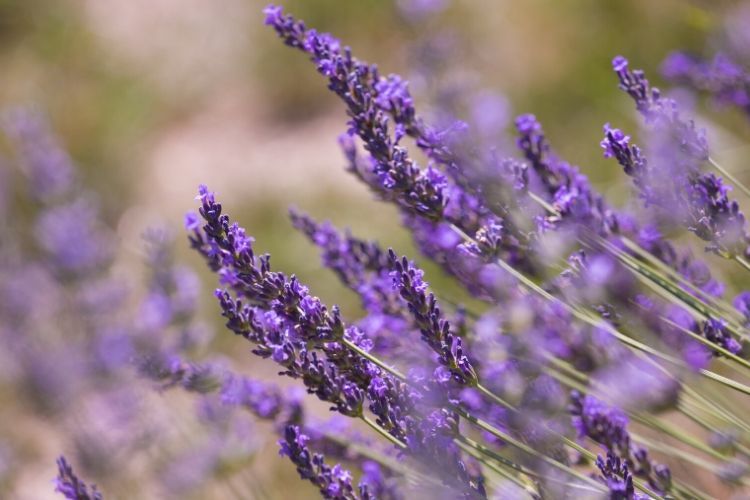
Of course, not everyone is on equal footing: those who, like me, are fortunate enough to live in a cold, rainy climate with heavy soil will find it much easier to successfully fail at growing lavender than those unfortunate enough to live in the sunny climes of Provence.
However, by carefully following these simple and practical tips, accessible to all, I am sure many will also manage to kill their lavenders.
Lesson 1: to kill lavender, smother it!
Lavender comes from the South; it loves southern, stony, well-drained soils. It hates heavy soils that rot its roots in winter, which is why good gardeners prefer to plant in spring rather than autumn.
It can be planted in heavy soil, but requires drainage work: a large planting hole, at least twice the size of the pot, adding gravel or river sand, or, if necessary, turf.
So, to fail at growing your lavender, plant it at the wrong season (between November and February, for example) in heavy clay soil, which you have not lightened or loosened, ideally in a hole that is too small (if necessary, give a few frustrated heel kicks to make it fit);
This is a very reliable method for failing at lavender, which I have practiced extensively in our potato fields up North.
A rather perverse variant of this method is to put your lavenders in the position of gladiators in the circus games: plant lavenders very close together, say 15 cm apart: they will shade each other, and, by fighting, weaken one another, and part (at least) of your plants will end up dying, while the others will blacken, which is quite an effect.
Lesson 2: to fail at lavender, drown it!
Lavender does not appreciate repeated excess watering: it is a Mediterranean climate plant.
To kill lavender, water abundantly, not only after planting (which it likes, like all plants), but also throughout its (short) life: it will disappear by the first winter. To speed up the killing, create a watering basin that will keep the root ball moist during the dreary season, guaranteed success!
Lesson 3: to fail at lavender, put it in the shade
Lavender loves the sun… In the shade, it withers, stretches its branches sadly in search of light, flowers little or not at all, and dies quickly.
By planting in the shade (a true marked shade, it can flower quite well in light shade), you will achieve a result similar to the previous lesson. You can even combine lessons 1, 2, and 3 for a better result.
Lesson 4: to fail at lavender, overfeed it!
Used to poor soils, lavender behaves very poorly in rich environments: it eats too much, grows and grows… And very quickly collapses lamentably, leaving an awful black hole in the centre.
This lesser-known method is particularly recommended for sensitive souls; it allows you to fail at growing lavender (and many other things) in good conscience, through excess care: plant it in rich potting soil, generously amended with compost, supplemented by regular overdoses of fertiliser, preferably chemical: you may not kill it, but you will surely give it a rather monstrous appearance of a Chernobyl plant.
Generally, it is enough to plant poorly to fail. However, for safety, in case your lavender shows resilience, here is a maintenance tip:
Lesson 5: to fail at lavender, prune it regularly in a 'para' style
Like almost all evergreen plants, lavender does not like heavy or short pruning.
Of course, you can safely cut the dry flower spikes once a year (and make lovely fragrant bouquets), or a few overly exuberant young shoots. But do not prune the wood: it never regrows on old wood!
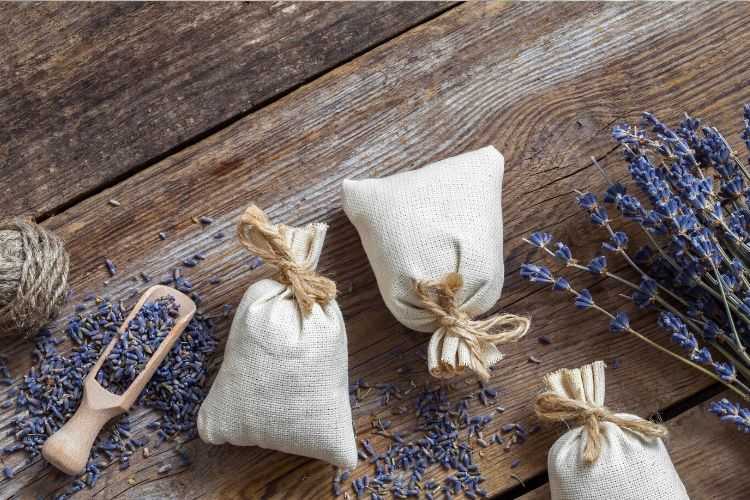
So to fail at lavender, prune it brutally and as short as possible: at the very least, you will make it look considerably ugly and prevent it from flowering properly; at worst, you will kill it. It is worth noting that even in Saint Rémy de Provence, this method works well.
Bonus tip for those who have had the courage to read everything, with a lazy method that I particularly recommend for its simplicity: you can also fail at growing lavender in a pot. Simply plant it in a small pot (say less than 20 cm), and do not water it. Admittedly, lavender does not like excess watering, but it is not a cactus: it needs water, which it seeks through a deep root system. For this reason, it does not settle well in a small pot (and above all, hates being moved).
You can therefore fail at it by simply keeping it in the tiny pot it came in when you bought it, while forgetting to water it!
Finally, to console the clumsy who, even by following these wise tips, still manage to keep a lovely fragrant lavender in the garden: even under good growing conditions, sun, well-drained soil, moderate watering, lavender does not age very well. It rarely lasts more than 10 years, especially in our Northern gardens, and generally becomes quite unattractive after 5 years: you will likely have the opportunity to see it die one day!
Discover everything you need to know about lavender to choose well, succeed in its cultivation, propagate it, or even dry it.
A friend of mine, who is also a well-known gardening columnist (and an excellent gardener, which makes for two significant differences between us), recently told me: “It annoys me, I can’t keep lavender alive…” This was, I must say, a huge relief for me: I was not alone in carrying this shameful secret: repeatedly failing […]
In my garden, I don't have the right soil to grow winter heathers. However, the little bees in the garden and I love them very much, both for their delicate melliferous bells in the cold season and for their evergreen and decorative foliage all year round. No matter, I grow them in pots and it works very well. In fact, my heathers are in bloom right now, come and see!
A heather with golden foliage in summer: Erica x darleyensis 'Eva Gold'
This heather has a compact habit, as well as beautiful and numerous magenta bells. But what makes it unique is its superb golden foliage in summer. This allows me to create a patchwork of colours simply with foliage.
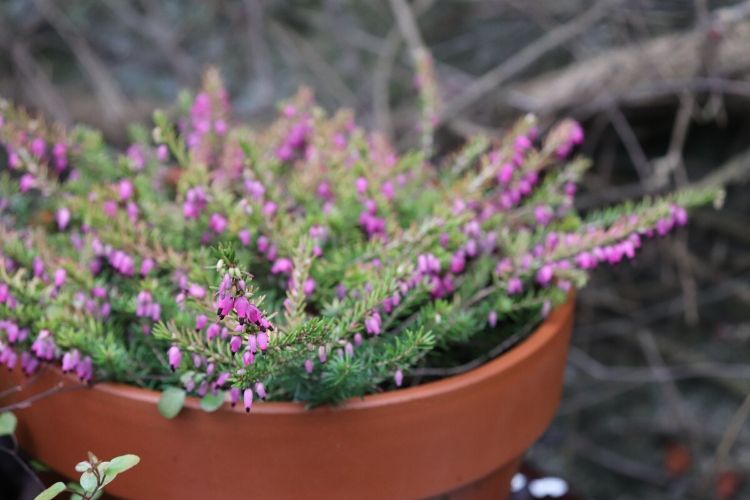
A white heather: Erica x darleyensis 'Silberschmelze'
We can agree, its name is quite a mouthful but its bright, pure white flowering literally melts my heart. Its foliage is not to be outdone as it also changes colour, shifting from light green to dark green and eventually reddening in the cold.
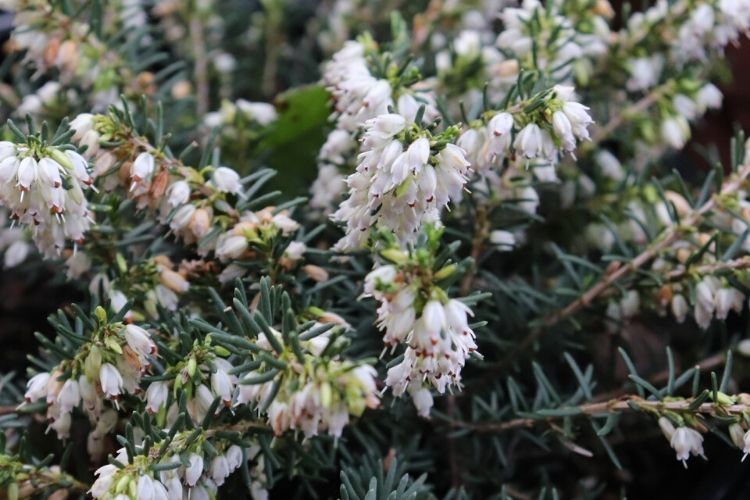
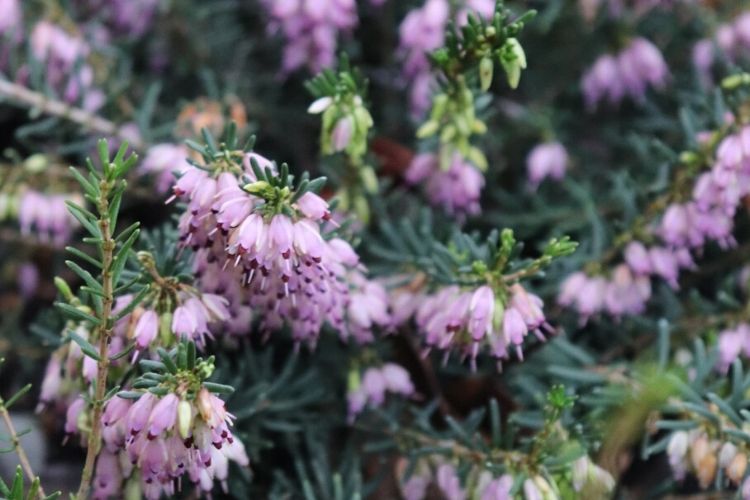
A lilac pink heather: Erica x darleyensis 'Darley Dale'
I couldn't resist this variety with its charming little lilac pink bells on beautiful dark green foliage. It is an old variety that has proven itself. It forms a dense, compact flowering cushion.
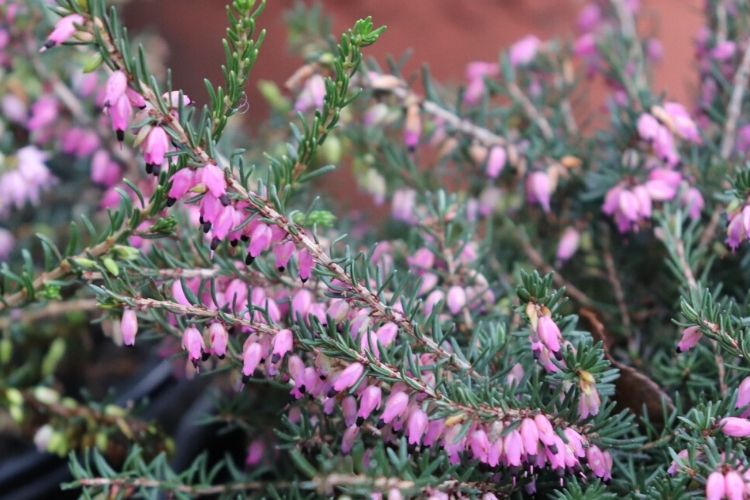
An essential heather: Erica x darleyensis 'Kramer's Rote'
This variety is one of the most appreciated and for good reason, it has all the qualities: vigorous, very floriferous, well compact, particularly accommodating. I love its bright dark pink flowers on its dark foliage that takes on bronze tones with the intensity of the cold.
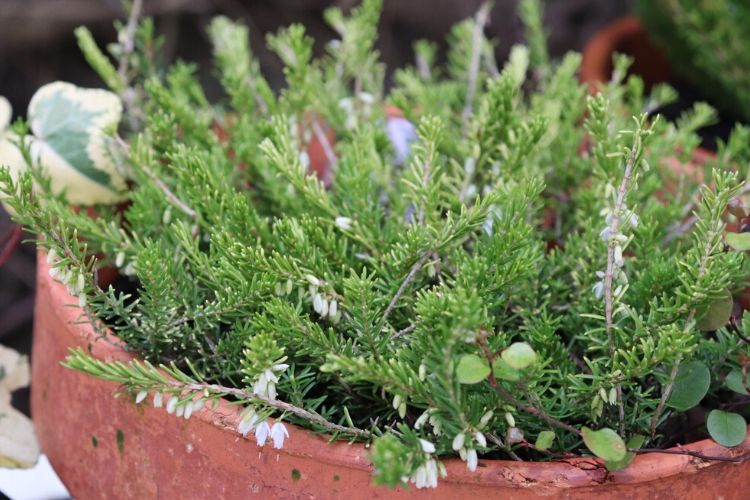
An alpine heather: Erica carnea 'Golden Starlet'
I conclude with a snow heather that offers a profusion of small white bells on very bright golden foliage in autumn/winter. It is just starting to show a few bells, but I’ll show it to you anyway, otherwise it will sulk!
How to plant a heather in a pot?
As I mentioned, heather is well-suited to pot cultivation. They need a very well-draining substrate. For this, I placed some shards and a layer of clay pebbles at the bottom of my pots. Then, I simply used good horticultural compost in which I planted my heathers. For maintenance, I give them a trim after flowering and I make sure to protect them from the intense summer heat. With a rather slow growth rate, they can stay in their pots for a few years without any issues. In my opinion, fertiliser is unnecessary, as heathers prefer rather poor soils. I will simply repot them into slightly larger pots when they seem cramped.
To learn everything about growing heathers, check out our guide: Heather: planting, pruning and maintaining.
In my garden, I don’t have the right soil to grow winter heathers. However, the little bees in the garden and I love them very much, both for their delicate melliferous bells in the cold season and for their evergreen and decorative foliage all year round. No matter, I grow them in pots and it […]
Agapanthus are spectacular flowers often found in seaside gardens, particularly along the West Coast and in Brittany. In summer, they display beautiful blue, white, or mauve flowers in umbels that are both graphic and elegant.
As a worry-free perennial, the Agapanthus thrives in full sun in ordinary, well-drained soil that is not too dry in summer. Its lightness and ease of cultivation are real assets for creating a flowering bed or a pot.
Historically, their use in gardens was limited by their lack of hardiness and the small number of varieties... Today, Agapanthus now come in many varieties, and some even show good cold resistance, which presents another challenge: choice!
To help you, here is a selection of 7 reliable Agapanthus that will suit all gardens, regardless of their size, style, or climate.
Agapanthus Navy Blue (Midnight Star): the hardy one
The Agapanthus 'Navy Blue', also known as Agapanthus ‘Midnight Star’, is one of the most popular Agapanthus. This variety ranks at the top for best rating and best seller at Promesse de Fleurs, and you'll soon see why!
Its light umbels bear an intense navy blue. They appear abundantly from July to August. Its light green ribbon-like foliage is deciduous, but this variety is one of the hardiest Agapanthus, with a resistance down to -10°C in well-drained soil.
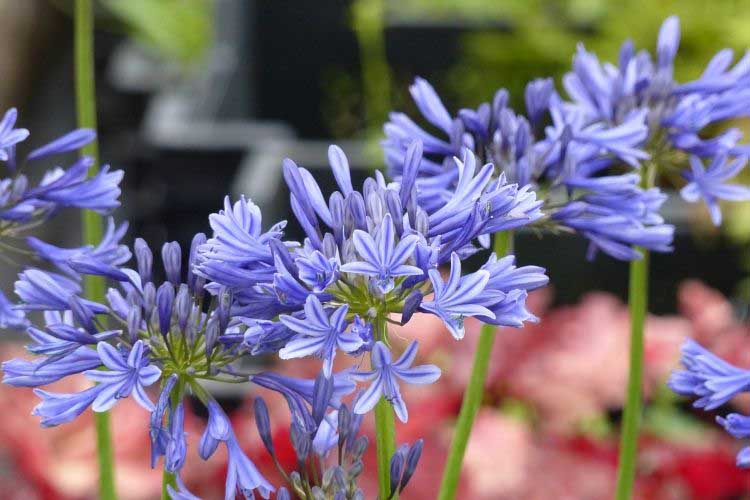
The hardy and popular Agapanthus Navy Blue
Vigorous and medium-sized, reaching 60 cm in height and 40 cm in spread, it adapts well both in pots and as a border plant.
→ To learn more about this variety, check out our article: "Agapanthus 'Navy Blue': a cold-resistant beauty"
Agapanthus Blue Giant: the iconic giant
The Agapanthus Blue Giant is a must-have perennial in Brittany! Often planted, it is valued for its very large dark blue flowers measuring 18 cm in diameter that can reach up to 1.5 meters in height. Its height makes it a remarkable plant for borders and backdrops. It creates significant, elegant vertical lines. You can also enjoy its beautiful large flowers as cut flowers.
Vigorous and robust with fleshy roots, it withstands temperatures down to -12°C.
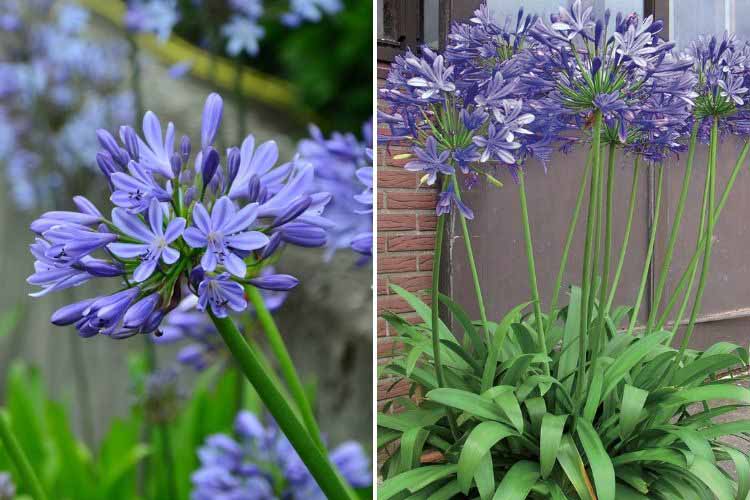
The Agapanthus Blue Giant reaches great heights
Agapanthus Albus: the essential one
Ideal for white gardens, the Agapanthus umbellatus Albus, also known as Agapanthus africanus albus, is distinguished by its white flowering. Its umbels of 15 cm in diameter rise to 1 meter above a ribbon-like semi-evergreen foliage. The umbels consist of snow-white flowers shaped like campanulas. Not very hardy, it tolerates temperatures down to -5°C, limiting its use to mild climates.
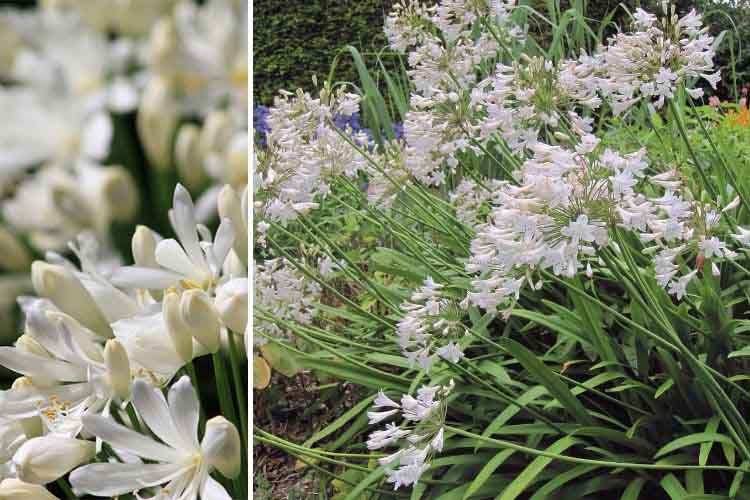
The white-flowered Agapanthus: Agapanthus albus
Agapanthus Royal Velvet: the new star
Original and recent, the Agapanthus Royal Velvet is a new star among Agapanthus due to its intense, trendy colour described as 'ultra violet'. It produces a stunning effect with its unique umbels of 10 to 12 cm in diameter, featuring a deep violet colour streaked with very dark blue-violet. The umbels rise to 80 cm above the ground, clearly above the (deciduous) foliage that forms a lovely clump. The elegance of the Agapanthus Royal Velvet is undeniable!
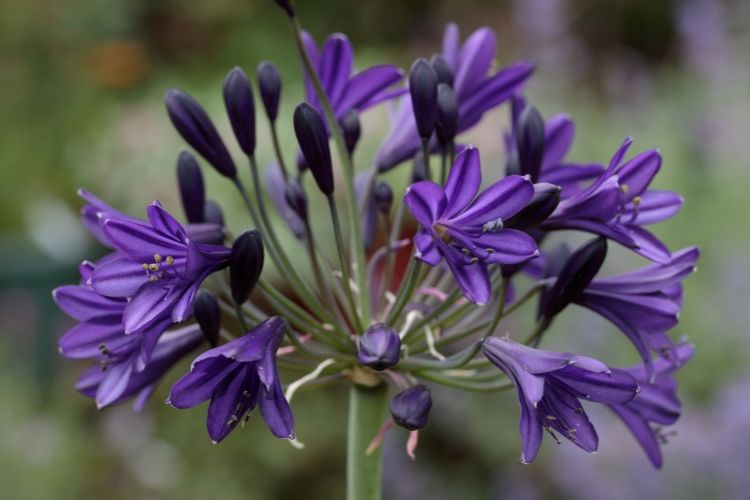
The Agapanthus Royal Velvet, a new variety with ultra violet flowers
Its intensely coloured flowers make it ideal for contemporary gardens as well as for exotic scenes featuring orange flowers like kniphofias, cannas, or hemerocallis.
In addition to its original colour, this variety boasts many advantages with its abundant flowering, robustness, and cold resistance down to -10°C.
Agapanthus Double Diamond: the compact one with double flowers
Recent, the Agapanthus Double Diamond is a variety that combines two qualities: a compact habit and generous flowering. Its main asset lies in its pure white double trumpet-shaped flowers. Grouped in umbels, they measure 10 cm in diameter and appear above a clump of persistent leaves in mild climates. Its compact habit (35 cm high and 30 cm wide) makes it ideal for pots, on terraces or balconies, as well as for borders in areas where winters are not too cold, as it does not tolerate temperatures below -5°C.
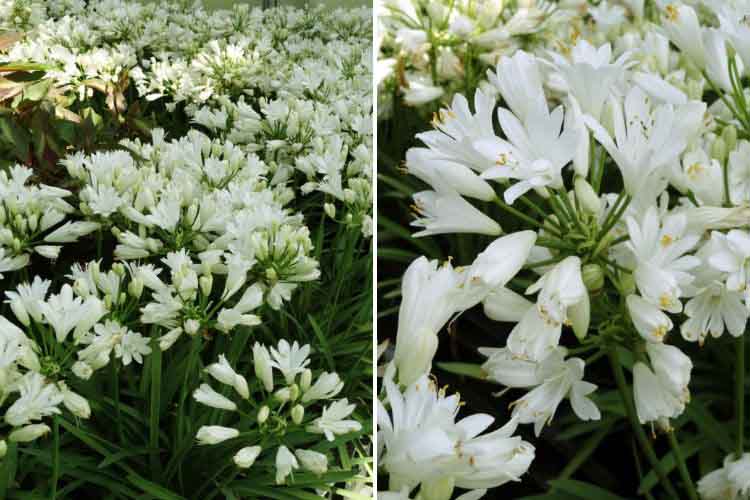 The Agapanthus Double Diamond, a small variety with generous double flowers
Agapanthus Twister: the bicolour
The Agapanthus Twister is an original variety appreciated for its bicoloured flowers. Large, up to 18 cm in diameter, its umbels consist of white flowers with a dark blue base. These two-coloured flowers provide a certain dynamism while blending the softness of the shades, accentuated by the green-grey foliage. Medium-sized, this Agapanthus reaches 60 cm in height and 50 cm in width, making it ideal for the middle of borders, behind ground-cover plants, and it can also be grown in large pots.
Finally, the Agapanthus Twister can be planted in many climates as it is one of the hardiest Agapanthus, tolerating temperatures down to -12°C.
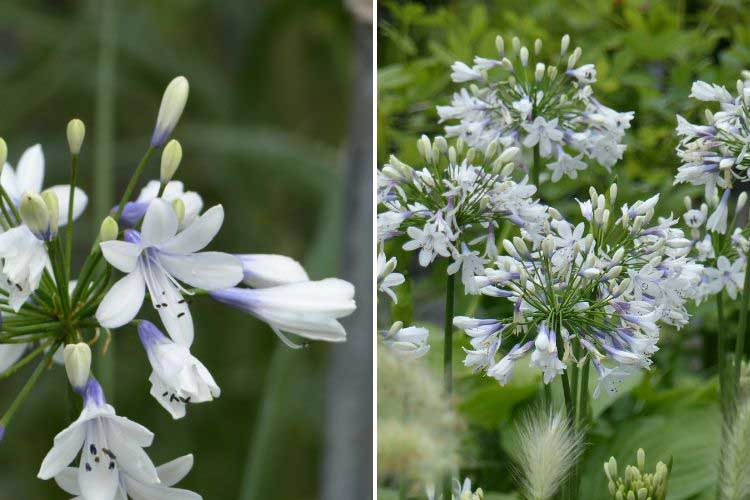
The Agapanthus Twister: bicoloured flowers, white and blue
Agapanthus Pitchoune Blue: the perfect cute pot plant
The Agapanthus Pitchoune Blue lives up to its name. All cute and small, this compact variety measures only 50 cm in height and 50 cm in width. Dwarf, it is perfect for border planting but also for pot cultivation, allowing it to be brought indoors for protection in winter, as it is not very hardy and only tolerates -5°C.
Although small, the Pitchoune Blue variety stands out for its abundant flowering. It pleasantly blooms in an overseas blue above persistent ribbon-like foliage. In the garden, it can be associated with or replaced by its "little sister" with white flowers, Pitchoune White, which offers the same qualities.
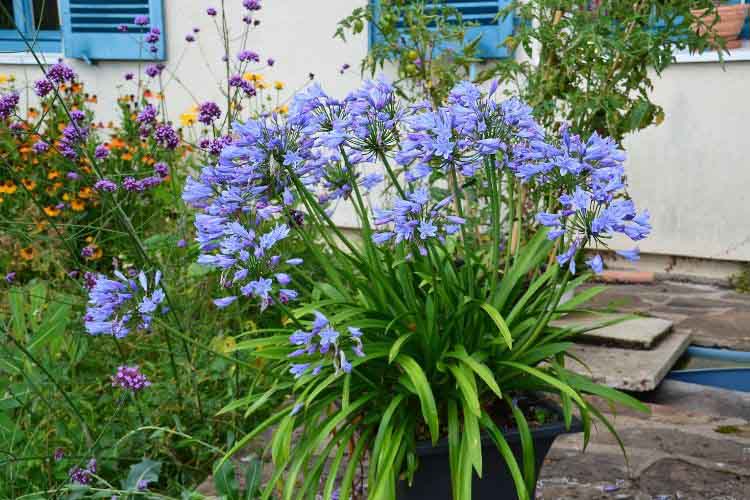
The Agapanthus Pitchoune Blue, a reliable choice, ideal for pots
Do you have other varieties to recommend? Feel free to share their names with us in the comments!
Agapanthus are spectacular flowers often found in seaside gardens, particularly along the West Coast and in Brittany. In summer, they display beautiful blue, white, or mauve flowers in umbels that are both graphic and elegant. As a worry-free perennial, the Agapanthus thrives in full sun in ordinary, well-drained soil that is not too dry in […]