Ranunculus asiaticus Butterfly Graces® - Persian Buttercup
Ranunculus asiaticus Butterfly Graces® - Persian Buttercup
Ranunculus asiaticus Butterfly Graces® - Persian Buttercup
Ranunculus asiaticus Butterfly Graces®
Persian Buttercup, Asian Buttercup
Back-to-school special offer!
Get €10 off for every €50 you spend! And get up to €40 off on a single order.
How does it work?
1. Shop your favourites
Add your favourite plants to your basket. For every €50 you spend (excluding delivery charges, store credit and the plastic-free option), you’ll receive a €10 voucher.
€50 spent = €10 voucher
€100 spent = €20 voucher
€150 spent = €30 voucher
€200 spent = €40 voucher
2. Place your order
Once your basket reaches one of the spending thresholds, place your order. You can even choose your delivery date!
3. Receive your voucher
As soon as your order has been shipped, you’ll receive an email containing your personal voucher code and its value.
4. Use it on your next order
Your voucher is valid for 90 days from the date you receive it. It can be used once only, on a new order worth at least the value of the voucher, excluding delivery charges.
Please note: Vouchers can be combined with other offers, but cannot be split or refunded.
Home or relay delivery (depending on size and destination)
Important: You may be charged customs duties by your country’s customs authorities upon delivery.
Schedule delivery date,
and select date in basket
This plant carries a 6 months recovery warranty
More information
We guarantee the quality of our plants for a full growing cycle, and will replace at our expense any plant that fails to recover under normal climatic and planting conditions.
Would this plant suit my garden?
Set up your Plantfit profile →
Description
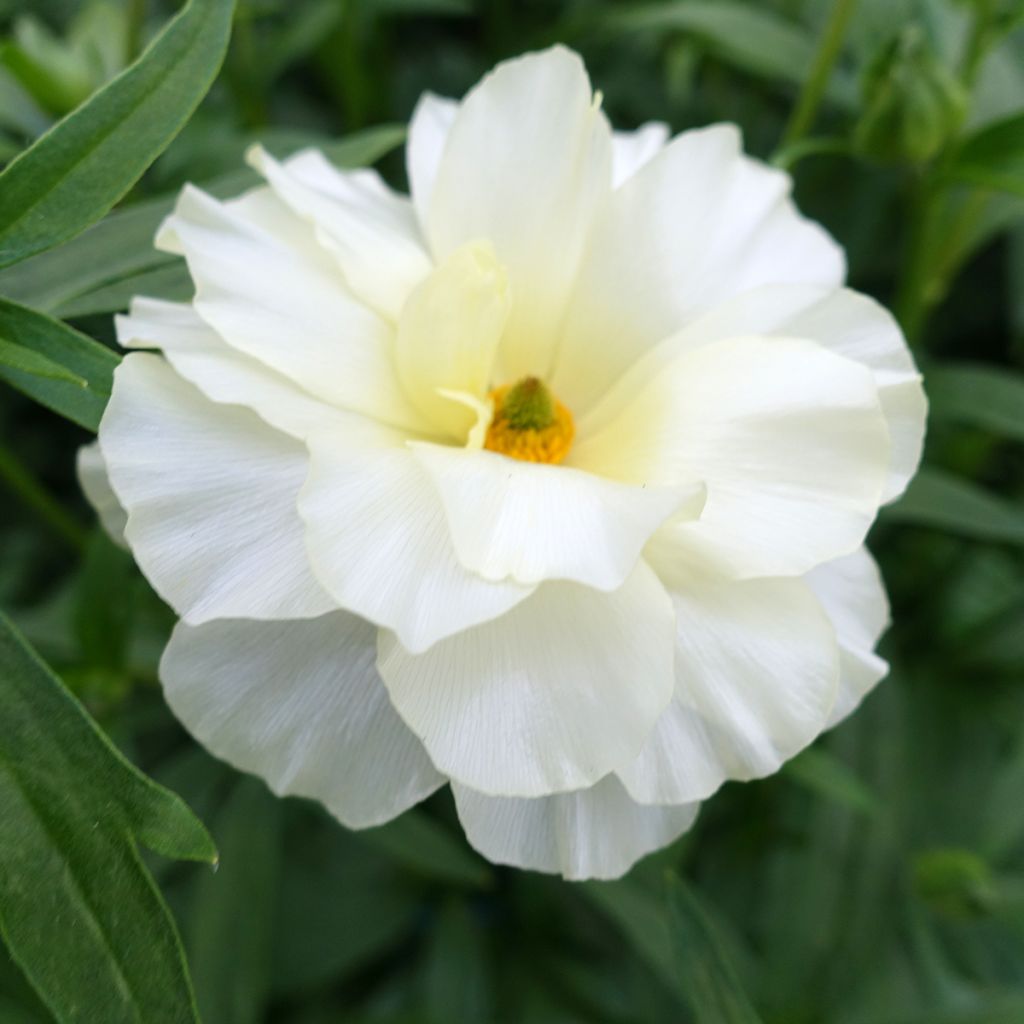
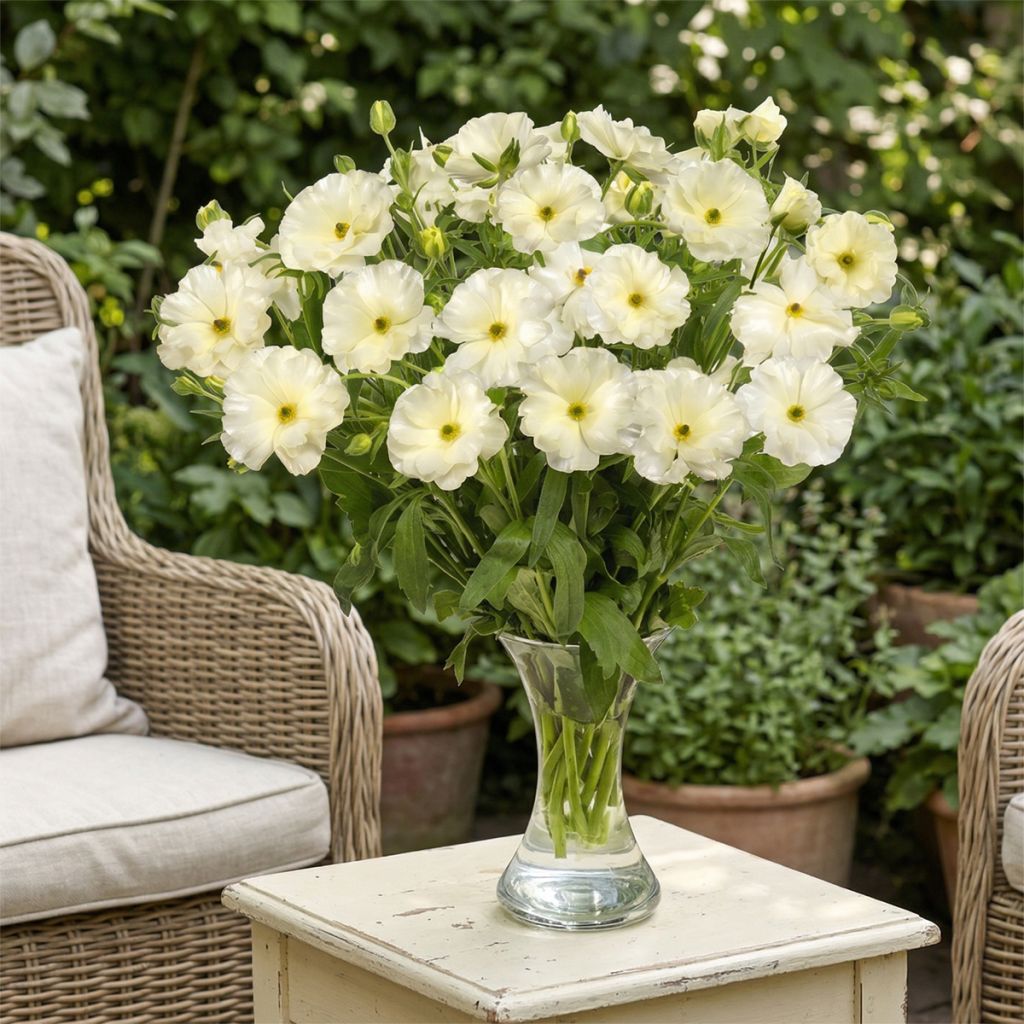
Butterfly™ Graces® brings a lightness and simple grace to the florist's ranunculus. Its creamy white, pearly flowers, numerous on each stem, seem to float above its foliage. The cut stems also offer excellent vase life. It is a valuable variety for spring cut flower arrangements, white borders and containers placed near the house to enjoy its charm.
This variety belongs to the Ranunculaceae family. Its ancestor is Ranunculus asiaticus, the Asian ranunculus, garden ranunculus or florist's ranunculus. It is a perennial, tuberous botanical species with fleshy claws. Its natural range covers the eastern Mediterranean and the Near East. It is found from the southern Aegean islands to western and southwestern Iran, in open, sunny, often stony environments, which are subject to a dry period in summer.
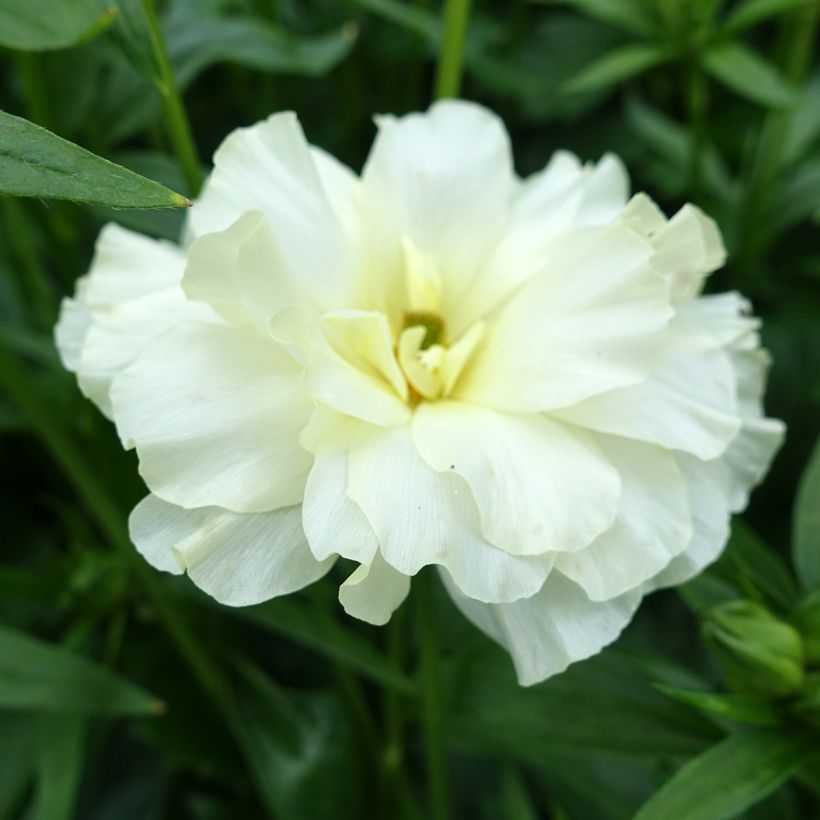
Butterfly™ Graces® belongs to the Butterfly™ series, resulting from the breeding work of the Japanese breeder Aya Engei. This series was developed for cut flowers: the plants produce branched stems, with several buds per stem, and single to semi-double or barely double flowers, covered by a thin waxy film that makes them shine and improves their vase life. Graces® produces cream to white flowers, lighter than those of Ariadne®, and buds tinged with lime green. The plant forms an upright clump 45 to 50 cm high and 20 to 30 cm wide in one season. In cultivation for cut flowers, stems can reach 55 to 70 cm. The stems are thin, sturdy, well-branched, and each bears 5 to 7 buds. The 6 to 8 cm wide corollas are open, supple, and slightly crinkled. The dominant colour is a creamy white to pale ivory, with a soft yellow-green heart and even greener buds, giving the whole a real freshness. Flowering occurs from April to June, sometimes earlier in mild regions. The bright green, deeply cut foliage forms a low clump from which the leafy flowering stems rise. The vegetation disappears after flowering when the plant goes dormant. The underground tubers don't like excess water and frost: they perish below -5/-6°C. Grow florist's ranunculus like a gladiolus, lifting the tubers before the first frosts.
Plant the Butterfly™ Graces® variety in borders and beds or in a container on the terrace. This spring flower deserves a prime location, to be studied up close. Always plant it in light, fertile, and very well-drained soil. It can be combined with the double daffodil ‘Obdam’, Viridiflora tulip ‘Spring Green’, peony ‘Immaculée’, China aster 'King Size White' and Allium ‘Mount Everest’. Gathered in the garden and then in a vase, these flowers compose a large and magnificent white bouquet.
The Asian ranunculus has been one of the most cultivated florist's plants for centuries. Its production is ancient in the Mediterranean basin and in Anjou, where the tubers have long been the subject of genuine horticultural expertise.
Ranunculus asiaticus Butterfly Graces® - Persian Buttercup in pictures
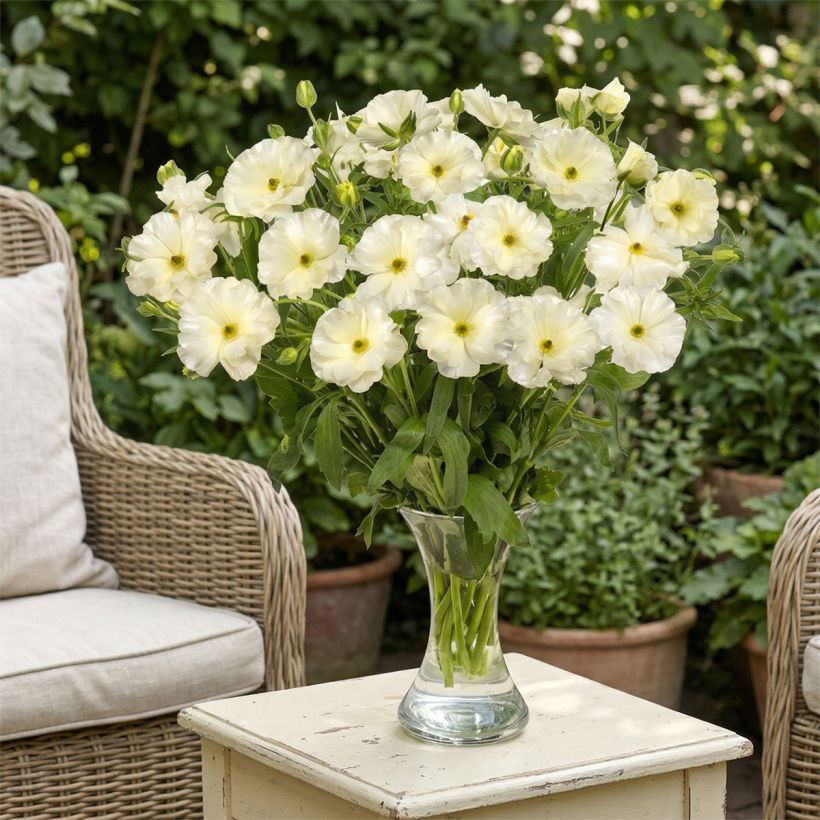
Plant habit
Flowering
Foliage
Botanical data
Ranunculus
asiaticus
Butterfly Graces®
Ranunculaceae
Persian Buttercup, Asian Buttercup
Cyprianthe asiatica, Ranunculus africanus, Ranunculus sanguineus, Ranunculus flammipetalus
Cultivar or hybrid
Planting and care
Plant florist's ranunculus Butterfly Graces in autumn, in mild climates or in pots, for early flowering (April-May). It can also be planted in spring, in cold climates, for summer flowering.
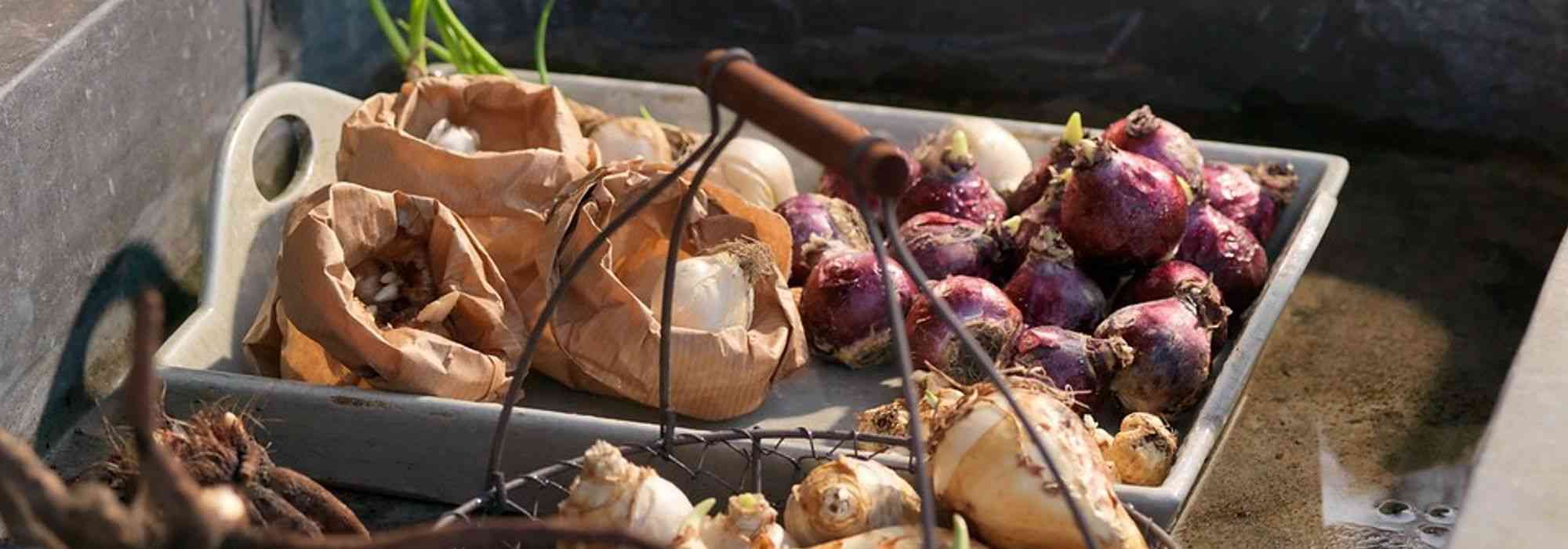
It thrives in partial shade as well as in full sun. Place it in moist, light soil, possibly enriched with coarse sand and humus-bearing. This plant dislikes calcareous soils. In autumn, lift the tubers and store them in a dry, cool place to protect them from frost, as they are not very hardy.
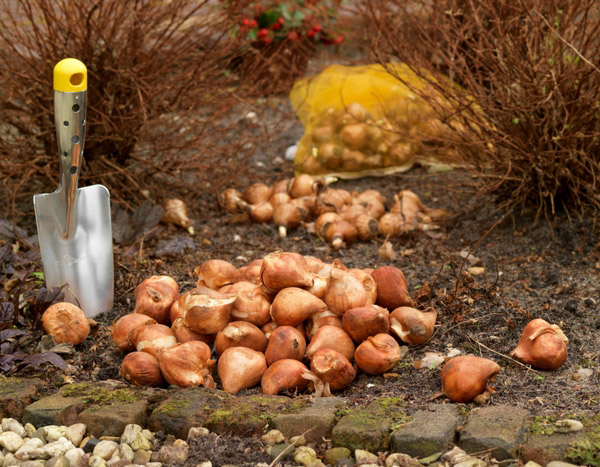
Before planting, we recommend soaking the bulbs for half a day. Plant the tubers in a mixture of equal parts garden soil, leaf mould and fairly coarse river sand. It flowers 120 days after planting.
Planting density: 16 to 20 bulbs per m².
Planting period
Intended location
Care
Planting & care advice
-
-
-
-
-
-
-
-

This item has not been reviewed yet - be the first to leave a review about it.
Recently viewed products
Haven't found what you were looking for?
Hardiness is the lowest winter temperature a plant can endure without suffering serious damage or even dying. However, hardiness is affected by location (a sheltered area, such as a patio), protection (winter cover) and soil type (hardiness is improved by well-drained soil).

The flowering period indicated on our website applies to countries and regions located in USDA zone 8 (France, the United Kingdom, Ireland, the Netherlands, etc.)
It will vary according to where you live:- In zones 9 to 10 (Italy, Spain, Greece, etc.), flowering will occur about 2 to 4 weeks earlier.
- In zones 6 to 7 (Germany, Poland, Slovenia, and lower mountainous regions), flowering will be delayed by 2 to 3 weeks.
- In zone 5 (Central Europe, Scandinavia), blooming will be delayed by 3 to 5 weeks.
In temperate climates, pruning of spring-flowering shrubs (forsythia, spireas, etc.) should be done just after flowering.
Pruning of summer-flowering shrubs (Indian Lilac, Perovskia, etc.) can be done in winter or spring.
In cold regions as well as with frost-sensitive plants, avoid pruning too early when severe frosts may still occur.
The planting period indicated on our website applies to countries and regions located in USDA zone 8 (France, United Kingdom, Ireland, Netherlands).
It will vary according to where you live:
- In Mediterranean zones (Marseille, Madrid, Milan, etc.), autumn and winter are the best planting periods.
- In continental zones (Strasbourg, Munich, Vienna, etc.), delay planting by 2 to 3 weeks in spring and bring it forward by 2 to 4 weeks in autumn.
- In mountainous regions (the Alps, Pyrenees, Carpathians, etc.), it is best to plant in late spring (May-June) or late summer (August-September).
The harvesting period indicated on our website applies to countries and regions in USDA zone 8 (France, England, Ireland, the Netherlands).
In colder areas (Scandinavia, Poland, Austria...) fruit and vegetable harvests are likely to be delayed by 3-4 weeks.
In warmer areas (Italy, Spain, Greece, etc.), harvesting will probably take place earlier, depending on weather conditions.
The sowing periods indicated on our website apply to countries and regions within USDA Zone 8 (France, UK, Ireland, Netherlands).
In colder areas (Scandinavia, Poland, Austria...), delay any outdoor sowing by 3-4 weeks, or sow under glass.
In warmer climes (Italy, Spain, Greece, etc.), bring outdoor sowing forward by a few weeks.
Shipping country and language
Your country of residence may be:
Your country of residence is:
For a better user experience on our website, you can select:
Your shipping country:
-
 Austria
-
 Belgium
-
 Bosnia & Herzegovina
-
 Bulgaria
-
 Croatia
-
 Cyprus
-
 Czechia
-
 Denmark
-
 Estonia
-
 Finland
-
 France
-
 Germany
-
 Greece
-
 Hungary
-
 Iceland
-
 Ireland
-
 Italy
Italy
-
 Latvia
-
 Liechtenstein
-
 Lithuania
-
 Luxembourg
-
 Malta
Malta
-
 Netherlands
-
 Poland
-
 Portugal
-
 Romania
-
 Serbia
-
 Slovakia
-
 Slovenia
-
 Spain
Spain
-
 Sweden
-
 Switzerland
Language:
-
French
-
 English
-
Spanish
-
Italian
-
German
-
Portuguese
-
Dutch
-
Finnish
My Account
Hello
My wish lists
My cart
Log in / Register
Existing customer?
This form is protected by reCAPTCHA - the Google Privacy Policy and Terms of Service apply.
New customer?
Create an account to track your orders, access our customer service and, if you wish, make the most of our upcoming offers.