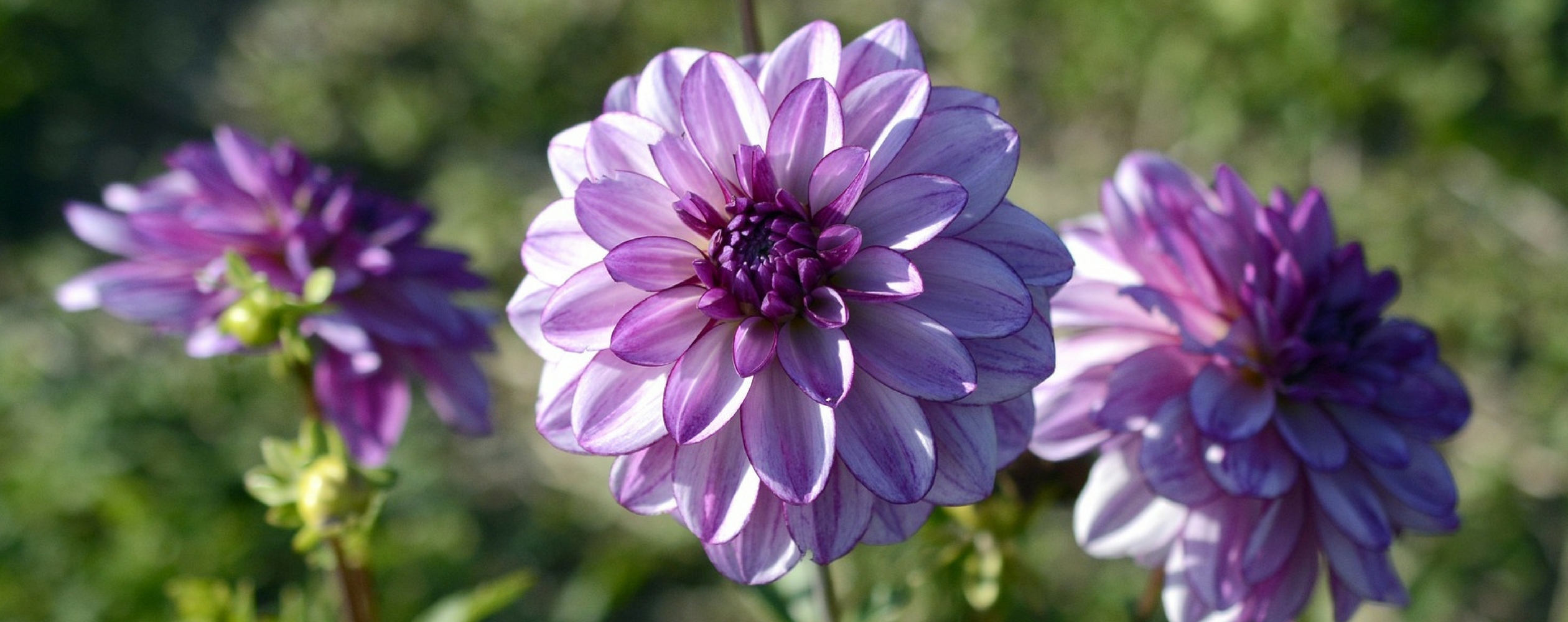
Dahlia: planting, care and growing tips
Contents
Dahlia in a nutshell
- The dahlia flowers abundantly and for a long time. Its uninterrupted flowering begins in summer and continues right up to the start of winter.
- Its camellia-, anemone-, cactus-, pompon- or peony-flowered blooms come in an infinite variety of shapes and colours.
- Whether giant, reaching up to 2 m, or dwarf, no more than 60 cm tall, there are hundreds of dahlia varieties to suit every garden.
- Not very hardy in most regions, its tubercles must be lifted and overwintered in a frost-free place.
- This is an essential flower for vicar’s gardens, colourful exotic beds, vegetable gardens, mixed borders, window boxes and summer bouquets.
A word from our expert
With its beautiful old-fashioned or highly architectural appearance and endlessly varied colours, dahlia has made a spectacular comeback in recent years, once again finding its place in naturalistic gardens as well as kitchen gardens, in single-colour or multicoloured summer flower beds, such as mixed borders, and in containers, to which it brings a romantic, whimsical or exotic touch.
Classic or extravagant, sophisticated or simple, discreet or exuberant, miniature or giant, this summer-flowering bulb belongs to a very large family with varied shapes, colours and sizes, offering gardeners unlimited choice. Dahlia in the garden is the promise of a summer full of colour! Why go without it?
Its single or very double flowers, with anemone, cactus or pompon forms, range from vivid to pastel in an infinity of shades. Orange with bronze highlights, coppery pink or apricot-magenta pink, straw yellow, crimson red, virginal white, lilac blue or indigo violet, they flower throughout summer and into autumn, from July to October without a break, creating fresh, colourful and original cut flower arrangements.
Whether it is a pompon dahlia, “giant” or “dwarf“, “bedding“, “ornamental“, “collarette”, “cactus” or “semi-cactus“, “landscape“, you are sure to find the dahlia you like among the more than 200 dahlia varieties available online, some of them exclusive varieties that we offer in the finest sizes available.
Dare to invite them into your garden and create bright, colourful displays!

Botany and description
Botanical data
- Latin name Dahlia
- Family Asteraceae
- Common name Dahlia
- Flowering July to November
- Height 0.15 to 2 m
- Exposure Full sun
- Soil type Neutral
- Hardiness Half-hardy (not below -5°C), susceptible to frost
Native to the high plateaux of Mexico and Central America, Dahlia belongs to the large Asteraceae family, like daisies, asters and coneflowers. There are 30 species and tens of thousands of cultivars: today, nearly 20,000 horticultural varieties can be found throughout the world. Most are derived from Dahlia pinnata and D. coccinea. Discovered in the 16th century, Dahlia was not introduced to Europe until two centuries later. Dahlia imperialis, the botanical species with single flowers, was very different from modern Dahlia.
From its origins in the dry regions of Mexico, it has retained its love of warmth and sunshine, but also an innate sensitivity to cold! Moderately hardy, Dahlia is very sensitive to cold, so its tubers must be overwintered in most of our regions because it is susceptible to frost. It cannot tolerate temperatures that remain below -5 °C for long periods. However, if stored in a frost-free place throughout the winter, it will flower again for many years.
Today, Dahlia has become widespread throughout France and can be found in all summer-flowering beds. Two main types are distinguished: large-flowered Dahlias grown from tubers, and dwarf bedding Dahlias, which are easily propagated by sowing. Among the most popular and widely grown are anemone-flowered Dahlias, orchid-flowered Dahlias, collarette Dahlias, ornamental Dahlias, pompon and ball Dahlias, cactus and semi-cactus Dahlias, giant Dahlias, and dwarf Dahlias, both single and double.

Dahlia flower shapes vary according to the varieties: ball, water-lily-flowered or cactus-shaped…
Dahlia belongs to a large family with highly varied forms, colours and heights. The tallest plants easily reach 1.50 m, or even more in fertile soil, and spread 45 to 80 cm wide. These include Dahlia imperialis, the botanical ancestor of the Dahlias grown in our gardens, which can reach 3 m in height. Intermediate Dahlias grow to between 80 cm and 1.10 m. Dwarf varieties, ranging from 0.25 to 0.70 m, do not need staking.
This perennial has swollen, tuberised roots joined in vascular bundles, like small potatoes. They are edible and were initially grown for consumption. However, their rather unpalatable roots were soon abandoned in favour of the plant’s exceptional flowering.
Rigid, tubular, upright, hollow and branched stems emerge from its bushy, upright crown, bearing inflorescences from July to October (until November in temperate climates) that keep renewing themselves throughout the summer without interruption.
Dahlia flowers have a strong character, with such a distinctive, exuberant personality that they stand out among a thousand. Its solitary head inflorescences consist of one or more rows of radiating ligulate florets surrounding, depending on the variety, a central disc of more or less visible pistils. The flowers range from 10 cm to 25 cm or more in diameter. They are classified according to the size of their inflorescences:
- Giant: more than 25 cm in diameter (Giant Dahlias)
- Large: 20 to 25 cm in diameter (Cactus, Ball Dahlias)
- Medium: 15 to 25 cm in diameter (water-lily-flowered Dahlias)
- Small: 10 to 15 cm in diameter (anemone-flowered, collarette and ornamental Dahlias)
- Miniature: less than 10 cm in diameter (pompon Dahlias)

Giant Dahlia ‘Emory Paul’ – ‘Mel’s Orange Marmalade’ – ‘Burlesca’
Giant Dahlias, such as Dahlia ‘Emory Paul’, produce enormous flowers up to 35 cm in diameter, the size of a dinner plate.
Another variable is the shape of the Dahlia flower, which is used as the basis for its classification. These ligulate flowers are unscented and may be single, semi-double or very double. The shape of the ligules varies between cultivars: rolled, flat or lace-like…
Ornamental Dahlias have no central disc, but produce large, double flowers with generally flat petals, rounded at the tips and slightly recurved, sometimes resembling a water lily or a camellia. Elegant semi-cactus or Cactus Dahlias bear long, rolled, pointed petals that form a tousled pompon-like heart, resembling a cactus flower, as in Dahlia Mel’s Orange Marmalade. In this group, the narrow, very slender ligules of the head are partly rolled over more than half their length. ‘Lace’ cactus Dahlias are characterised by large, dissected flowers with slender, flat or rolled petals ending in forked tips, reminiscent of lace.
Others, formed by a crown of broader ligules surrounding a very double heart of smaller florets, resemble an anemone. Some Dahlias have long, incurved or reflexed ligules arranged in a star shape, resembling an orchid.
Collarette or single-flowered Dahlias have just one simple ring of petals around a central disc surrounded by an inner collar of shorter ligules. The heart and tips very often provide a striking contrast, as in Dahlias ‘Pooh’ and ‘Fashion Monger’.
Full of character, Honka Dahlias bear star-shaped flowers with fine, tightly rolled petals that are separate from one another around an orange centre, making them look like delicate windmills or curious spiders.
At the other extreme are pompon Dahlias, very architectural, whose tubular ligules form a spherical inflorescence about 10 cm across in the largest varieties, sometimes flattened at the top, with an alveolate structure, resembling a honeycomb, as in Dahlia ‘Burlesca’. Ball Dahlias produce flowers similar to pompon Dahlias, but larger, reaching 12 cm in diameter.
Dahlia flowering offers an incredible wealth of colour. Its flowers come in an infinite palette ranging from pale pink to lilac-pink, wine red to crimson, apricot to carmine salmon, pure white to café au lait or primrose yellow, and indigo violet to lilac-blue. ‘Worton Blue Streak’ is currently the bluest cactus Dahlia!
With excellent vase life, Dahlia heads make wonderful, colourful summer bouquets. Some varieties, such as Dahlia ‘Karma Lagoon’, have been specially developed as cut flowers.
Deciduous, its abundant foliage creates a luxuriant effect and highlights the exotic colours and voluptuous forms of the flowers. The opposite, finely toothed leaves are 20 to 50 cm long. They may be pinnate or very rounded and divided into three to five more or less leathery leaflets. The colour of the foliage also allows for beautiful variations, ranging from soft green to emerald green, bronze green or even purple, depending on the different types, as in ornamental Dahlia ‘Purple Flame’, Happy Single ‘Juliet’ and Dahlia Happy Single ‘Flame’.

Dahlia ‘Pooh’ – ‘Happy Single Juliet’ – Honka ‘Pink’ – ‘Fashion Monger’
Contrary to popular belief, Dahlia is not difficult to grow, but it does require some attention. It will only thrive and flower abundantly in a warm, sunny position. Although it adapts to all soils, it thrives in fertile, humus-rich, moist but well-drained soil, preferably neutral rather than acidic or chalky. It likes light soils that remain moist, and should be kept sufficiently damp with a good mulch during the growing season. Dahlia does not tolerate stagnant water, especially in spring and autumn. Moist soil enables it to grow vigorously. It needs soil rich in organic matter to flower well. It will never be luxuriant and will languish in poor, sandy soil. Tall Dahlias are not very resistant to wind or heavy rain. To avoid rather unattractive staking, it is better to give them a position sheltered from prevailing winds, which could cause the stems to flop.

Dahlia ‘Ridel’ and Hordeum jubatum (foxtail barley) – credit-Noun – MAP
A must-have in a vicar’s garden, Dahlia is a versatile, floriferous plant that brings colour, structure and originality to beds, rock gardens, borders, containers and the vegetable garden alike. Dahlia can be grown as a solitary plant, but is best planted in groups, in the middle or at the back of a sunny bed, combined with grasses and other vigorous perennials that will provide support and prevent their flowering stems from flopping unattractively. Reserve dwarf varieties for borders or window boxes. Magnificent in beds, ornamental Dahlias make excellent cut flowers for bright, colourful summer bouquets.
This plant was named ‘dahlia’ in honour of the Swedish botanist Andreas Dahl.
Main species and varieties
There are 30 species and tens of thousands of Dahlia hybrids: today, nearly 20,000 horticultural varieties can be found throughout the world. Most are derived from Dahlia pinnata and D. coccinea. Discover our colourful collection of dahlias, varying in flower shape and offering an infinite palette of colours. They are classified according to the shape and diameter of their flowers, from dwarf to giant. From the most classic to the most surprising, whether it is a “ball”, “giant” or “dwarf” Dahlia, a “bedding”, “collarette”, “decorative”, “cactus” or “semi-cactus” type, a “Honka”, “orchid-flowered”, anemone-flowered or camellia-flowered variety, you are sure to find the dahlia that suits you among the more than 200 varieties, including some exclusive selections that we offer in the finest available sizes. Dare to mix, pair and combine them, and you will brighten up your rockeries, beds, containers and mixed borders for several months at a time!
They are characterised by large flowers formed of a crown of flattened petals surrounding a very full centre of smaller florets. Their unusual, sometimes contrasting colours inevitably attract every eye. This group includes tall varieties to incorporate into perennial beds, as well as dwarf varieties, ideal for pots or for creating pretty summer bouquets.

Dahlia Blue Bayou
- Flowering time July to October
- Height at maturity 1 m

Dahlia Anemone Soulman
- Flowering time July to October
- Height at maturity 70 cm
This is a horticultural category defined by the shape of the flower, which… resembles a cactus flower! They bear very large, double flowers measuring 12 to 20 cm, with a beautifully ruffled appearance and narrow, pointed petals that are completely rolled up. Semi-cactus dahlias have similar flowers, but with narrower ligules that are only partly rolled and less tightly curled. The tallest varieties provide a surprising focal point at the back of a bed. Dwarf cactus dahlias, which do not exceed 60 cm in height, are perfect for borders or the front of a bed.

Dahlia Urchin
- Flowering time July to October
- Height at maturity 1 m

Dahlia Blue Record
- Flowering time July to October
- Height at maturity 60 cm
In this group, the flowers are single, with a ruffled, contrasting centre. The broad, flat ligules of the head are arranged regularly in a crown around a collar of short petals that reveal a yellow centre. The collar, often a different colour, provides a striking contrast. Dwarf varieties, which do not exceed 40 cm in height, are simply sensational in flower borders and pots.

Dahlia 'Pooh'
- Flowering time July to November
- Height at maturity 1,20 m

Dahlia 'Impression Fantastico'
- Flowering time July to November
- Height at maturity 40 cm
They are distinguished by large, double, full flowers formed of numerous ligules, varying from broad to narrow and flat, with rounded or slightly curly tips. This is a very heterogeneous group, including giants with flowers exceeding 20 cm in diameter, as well as smaller varieties bearing flowers reminiscent of camellias, water lilies and chrysanthemums.

Dahlia Café au Lait
- Flowering time July to October
- Height at maturity 1,20 m

Dahlia Duke Duweno
- Flowering time July to November
- Height at maturity 80 cm

Dahlia Happy Butterfly
- Flowering time July to October
- Height at maturity 1,10 m
These are the dahlias with the largest flowers. Majestic in appearance, they can be seen from a distance, with stems reaching almost 1.50 m and enormous, dinner-plate-sized flowers that can exceed 35 cm in diameter! With their subtle or intense colours, they are spectacular at the back of a perennial bed or in the kitchen garden. They often need staking.

Dahlia Myrtle's Folly
- Flowering time July to October
- Height at maturity 1,20 m

Dahlia Barbarossa
- Flowering time July to October
- Height at maturity 1,20 m
Their small size makes them essential for growing in pots, window boxes or grouped along the edge of a bed. This group includes the Gallery Dahlias, around 45 cm tall, which offer continuous flowering in sumptuous colours and shapes; the dwarf cactus dahlias, 50 to 60 cm tall, sublime with their large, colourful double flowers; and the Happy Single collection, with vibrantly coloured single flowers that do not exceed 60 to 80 cm.

Dahlia Happy Single Juliet
- Flowering time July to October
- Height at maturity 60 cm
They are distinctive for their inflorescences, formed into perfect balls with an alveolate structure reminiscent of a honeycomb. The difference between pompons and balls lies in the size of their heads: pompon dahlias have smaller flowers, no more than 10 cm across, while ball dahlias range from 6 to 12 cm. These spherical flowers are perfect for creating perfectly round bouquets and bringing a colourful, architectural touch to beds.

Dahlia Pompom Burlesca
- Flowering time July to October
- Height at maturity 90 cm

Dahlia Icoon
- Flowering time July to October
- Height at maturity 1 m
Discover other Dahlias
View all →
Available in 1 sizes

Available in 1 sizes
Available in 1 sizes
Available in 1 sizes
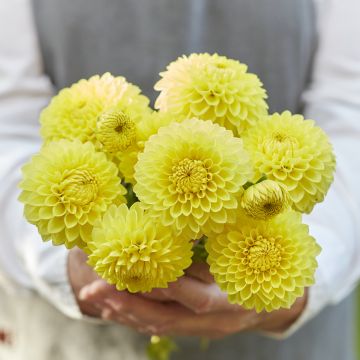
Available in 1 sizes

Available in 1 sizes
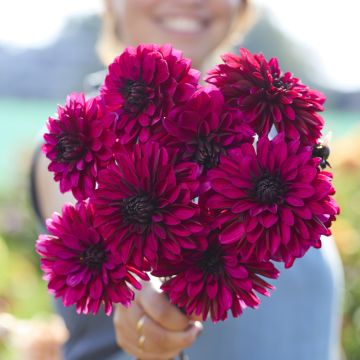
Available in 1 sizes
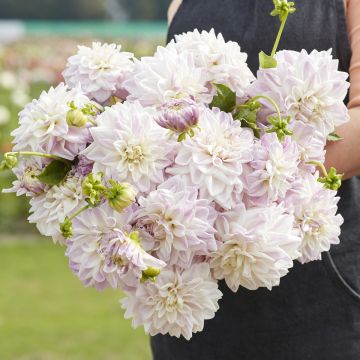
Available in 1 sizes

Available in 1 sizes
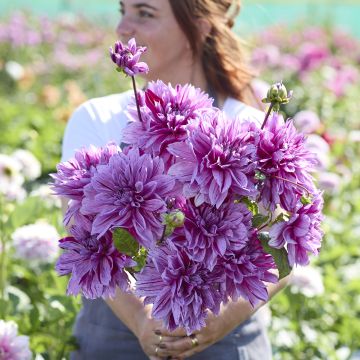
Available in 1 sizes
Planting dahlias
When to plant?
With dahlias, there is no point in rushing, you need to plant at the right time: if planted too early, the first shoots may be eaten by slugs. Tubers stored under cover over winter should be planted in spring, in March after the last frosts. In colder regions, wait until the end of April or the beginning of May, once the soil has warmed up and can be worked. Simply store dahlias bought in packets under cover, protected from frost, until the right planting time.
Where to plant?
Dahlias grow almost anywhere in France. The essential condition for having thriving dahlias is to plant them in full sun. The second requirement is to give them well-drained soil where water does not stagnate, especially in spring and autumn. Dahlias like light soils that remain cool and are kept sufficiently moist with a good mulch during the growing season. However, stagnant moisture would encourage the tubers to rot.
Although it grows in any soil that is not too acidic or chalky, it thrives in good, fertile garden soil, rich in humus, cool and well drained, preferably tending towards neutral. Dahlia is a hungry plant: to flower well and gain vigour, it needs a good basal fertiliser. If you are unsure about the soil’s nutrient content, add fertiliser (compost or manure) in autumn.

Dahlias can be planted in beds or in the vegetable garden
Tall dahlias do not withstand strong winds or heavy rain very well. A position that is too exposed to wind could dry out the foliage and, above all, cause the stems to flop. It is better to give it a position sheltered from the prevailing winds. For tall dahlias, staking may prove essential to support the flowerheads and prevent the stems from snapping in the slightest gust of wind, especially when they are planted on their own. To prevent their flower stems from collapsing in the middle of a bed, it is also preferable to plant dahlias with other plants and shrubs, which they can lean on.
When planting, allow it enough space for its eventual size within the display of your beds. Make sure that each young plant remains easily accessible for fertilising, staking, disbudding and overwintering.
Although it fits into every garden setting, including the vegetable garden, Dahlia is at its best as a mid- or back-of-border plant, where it adds a vibrant splash of colour.
Dwarf varieties are better suited to sunny borders, path edges or growing in pots on a sunny terrace or balcony. Dahlias in pots should be planted in good potting compost, watered very regularly and given a good fertiliser specially formulated for bulbs.
How to plant?
Dahlia is a very hungry plant. To meet its requirements in terms of soil fertility, it is best to loosen the soil in autumn, adding a basal fertiliser, or just a few days before planting. If your soil is too heavy, add potting compost and grit to soil where water tends to stagnate.

Planting the tubers
From mid-April onwards, as soon as the soil can be worked deeply, plant your dahlias.
- Space tall dahlias 80 to 100 cm apart
- Space small varieties 30 to 50 cm apart.
- Work the soil to a width and depth of 20 cm, mixing in, for example, a handful of roasted horn meal or dried blood with your well-crumbled garden soil. Dahlia is a hungry plant: it needs a good basal fertiliser.
- Position the tubers so that the collar is 5 cm below soil level.
- Cover them with around 10 cm of soil.
- Place stakes for the tallest species, taking care not to damage the tubers. This will above all help you identify where you have buried your dahlias!
- Water generously and then regularly for the first 6 weeks to help them root.
- Scatter a few slug pellets around the crowns you have planted to allow the first shoots to emerge.
- Then mulch the soil once growth has become established
→ Read also: Planting Dahlias: 8 Common Mistakes to Avoid and How to force dahlias to flower earlier?
Read also
The best Dahlias for bouquetsOverwintering dahlia tubers
Dahlias are extremely tender and fear frost. In regions with harsh winters, where the thermometer regularly falls below -5 °C, lifting is obligatory if you want to keep them alive. In regions with mild winters where frosts are light and infrequent, and in well-drained, sandy soil, the tubers can be left in the ground over winter, simply protected by a good mulch of dry leaves or straw. Lifting allows you to divide the tubers and start them into growth in pots, resulting in earlier flowering.
At the end of October or beginning of November (not before, as the roots would not have sufficient reserves for the winter), when the plant starts to weaken and the first frosts begin to blacken the leaves, it is time to dig up the tuberous crowns. The aim is simple: protect them from frost!
- As soon as the foliage has been blackened by frost, cut the stems back to 15 cm, close to ground level.
- Carefully dig up the tubers using a digging fork.
- Remove as much soil as possible from between the tubers.
- Label each crown at the base of the stem so that you can easily identify the plants in spring.
- Place the tubers on a layer of turf, dry sand or dry leaves in a cardboard box or a deep crate.
- Cover the tubers with a layer of turf or dry leaves.
- Store them away from light, draughts, rodents and… above all, frost, in a dry, cool, well-ventilated and dark place where the temperature does not exceed 4 to 5 °C (a dry cellar, garage or frost-free loft). Under these ideal conditions, dahlias keep very well, with virtually no risk of losses.
- Check the condition of the plants regularly to detect any diseases.
→ Read also: How to overwinter dahlias to protect them from frost?, How to store bulbs properly? and Overwintering Dahlias: should you lift them?
Care and maintenance
Dahlia is fairly easy to grow, but does require a little attention. A few simple steps will ensure you enjoy a summer full of flowers.
- In spring, protect young shoots from slugs.
- During the growing season, Dahlia is thirsty. Water generously when the buds are developing.
- In July, mulch with a 2cm layer of dry straw or peat to retain moisture throughout the summer. Water the mulch.
- Stake the stems of tall plants if necessary as the plant develops.
- Tie up the young stems.
- Two to three weeks after planting, pinch out the terminal shoot to encourage the plant to branch and increase flowering, especially if the tubers produce only one single stem. This will spread the plant’s habit, making it more resistant to bad weather, and may mean that it does not need an unsightly support.
- To produce larger flowers, pinch out the side buds afterwards.
- Remove the small shoots from the leaf axils: the flower heads will be all the larger.
- Remove faded flowers to encourage new ones to appear and extend the flowering period.
- Water very regularly, and twice a week during hot weather, at the base of the plant rather than over the foliage.
- At the end of summer, apply an organic fertiliser to encourage growth.
- In autumn, incorporate a good quantity of manure or well-rotted compost into the garden soil.
Pests and diseases
Dahlia is susceptible to slug attacks, which will make short work of its young shoots in spring. Fern manure or wood ash will drive them away. Later in the season, aphids can attack young stems bearing buds: control them with diluted soft soap. Earwigs, meanwhile, love the tender petals, but their voracious appetites do not harm the plant’s health. The plant may show signs of nutrient deficiency (thin stems, yellow leaves and small growth) caused by a lack of nourishment. Apply a compost mulch and a complete fertiliser. Grey mould can affect the tubers in cases of excessive moisture.
→ Find out more about dahlia diseases and pests in our advice sheet!
Propagation
By propagation from cuttings
This is the best way to obtain a large number of plants, but it is rather time-consuming, so we recommend dividing your tubers instead. Take cuttings from tubers that have been started into growth. At the beginning of March, take the roots out of storage, where they have spent the winter, and place them in a new mixture of compost or damp turf. It will take three weeks for shoots to appear. Take the cuttings when these shoots are about 10cm long. Pot them up under a cold frame, then re-pot them. They can be planted out in the open ground at the beginning of June.
By dividing the tubers
This is the simplest method. It can be done just before planting.
- In spring, at the end of March, take the roots that have overwintered in storage.
- Using a sharp knife or secateurs, divide the tubers into two or three pieces, making sure that each one has a piece of the old stem with an eye, from which the new shoots will emerge.
- Brush the cuts with wood charcoal.
- Do not plant between mid-April and the beginning of May unless small buds have appeared. If not, wait and water to encourage them to emerge.
Discover our video tutorial on dividing dahlias:
To find out more, discover our tutorial: Propagating Dahlias: the right techniques. Read also: How to sow Dahlias?
Pair
A must-have in a vicar’s garden, Dahlia is a versatile floriferous plant that brings colour, structure and originality to beds, rockeries, borders, flower-filled pots and the vegetable garden alike. Dahlia can be grown as a solitary plant, but is best planted in groups in the middle or at the back of a sunny bed, combined with grasses (Panicum, Molinia, Calamagrostis), and other vigorous perennials (Cosmos, Asters, Coneflowers, Cannas) which will act as supports, preventing their flowering stems from flopping unattractively.

Dahlias ‘Purple Flame’ – Calamagrostis – Asters – Coneflowers –
Landscape dahlias, pom-pom dahlias and Honka dahlias with pointed petals will create light, airy displays. Gallery dahlias, dwarf varieties such as Happy Single dahlias and collarette Dahlias (‘Impression Fantastico‘) are best reserved for borders or planters. Magnificent in beds, decorative Dahlias also make excellent cut flowers for bright and colourful summer flower arrangements.
Would you like a little more inspiration? Discover our advice guide: “Dahlias: how to pair them well in the garden”
Useful resources
- The finest collection of dahlias is here; Our new gladiolus and dahlias for spring 2022; Our new dahlias for spring 2023
- All our new dahlias are on our website!
- 3 settings with dahlias to discover on our blog
- Don’t miss planting your dahlias – follow our advice!
- How to divide your dahlias All the tips in our advice sheet
- Discover how to overwinter your dahlias with our video tutorial
- Should you lift dahlias? Ingrid has the answer on our blog
- Indigo violet, mahogany or pale pink, with Sophie, discover the full range of dahlia colours on our blog
- See dahlias at the Parc floral de Paris, officially recognised as a botanical garden since 1998, where several hundred dahlia varieties are listed!
- Discover our 7 ideas for combining plants in beautiful summer planters
- Discover how to grow a Dahlia in a pot
- Discover the best ball dahlias
- Discover how to pinch dahlias to produce more flowers
- Discover 5 giant dahlias to plant at the back of a border
- Find our advice on growing dahlias in hot weather
- We present 5 dahlias for planting in a border
- A bouquet of dahlias for €1 – is it possible? Discover it in our article!
- Subscribe!
- Contents
This form is protected by reCAPTCHA - the Google Privacy Policy and Terms of Service apply.